Question
Two parallel wires carry equal currents of 10A along the same direction and are separated by a distance of 2.0cm. Find the magnetic field at a point which is 2.0cm away from each of these wires
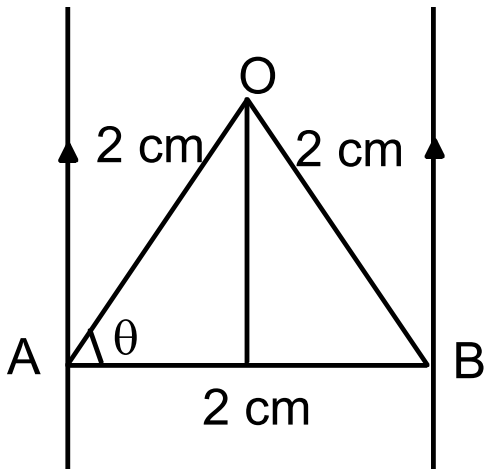
Answer


$\cos\theta=\frac{1}{2},$

$\theta=60^\circ\ \&\ \angle\text{AOB}=60^\circ$

$\text{B}=\frac{\mu_0\text{I}}{2\pi\text{r}}=\frac{10^{-7}\times2\times10}{2\times10^{-2}}=10^{-4}\text{T}$

So net is $[(10^{-4})^2]+(10^{-4})^2+2(10^{-8})\cos60^\circ]^\frac{1}{2}$

$=10^{-4}\Big[1+1+2\times\frac{1}{2}\Big]^\frac{1}{2}$

$=10^{-4}\times\sqrt3\text{T}$

$=1.732\times10^{-4}\text{T}$

Need a full question paper?

Generate a complete, print-ready paper with questions like this in minutes — across 16+ boards, with answer keys.

Start Generating Free

Similar questions

The temperature and relative humidity in a room are 300K and 20% respectively. The volume of the room is 50m3. The saturation vapour pressure at 300K is 3.3kPa. Calculate the mass of the water vapour present in the room.
A hot gas emits radiation of wavelengths 46.0nm, 82.8nm and 103.5nm only. Assume that the atoms have only two excited states and the difference between consecutive energy levels decreases as energy is increased. Taking the energy of the highest energy state to be zero, find the energies of the ground state and the first excited state.
Draw a circuit diagram of a C.E. transistor amplifier. Briefly, explain its working and write the expression for (i) current gain, (ii) voltage gain of the amplifier.
Write the principle of working of a potentiometer. Describe briefly, with the help of a circuit diagram, how a potentiometer is used to determine the internal resistance of a given cell.
A sinusoidal voltage of peak value 283 V and frequency 50 Hz is applied to a series LCR circuit in which $R =3 \Omega, L=25.48 mH$ and $C =796 \mu F$. Find
(a) The impedance of the circuit.
(b) The phase difference between the voltage across the source and the current.
(c) The power dissipated in the circuit.
A plane electromagnetic wave travels in vacuum, along the Y-direction. Write down the:
  1. Ratio of the magnitudes,
  2. The direction, of its electric and magnetic field vectors.
A resistor R and an inductor L are connected in series to a source $\text{V}=\text{V}_0\sin\omega\text{t}.$
Find:
  1. Peak value of the voltage drops across R and across L,
  2. Phase difference between the applied voltage and current. Which of them is ahead?
(a) For what Kinetic energy of a neutron, will the associated de-Broglie wavelength be $1.40 \times 10^{-10} m$ ?
(b) Find the de-Broglie wavelength of a neutron, in thermal equilibrium with matter, having an average Kinetic energy of $\frac{3}{2} K_{ a } T$ at 300 K . $\left[ K _{ B }=1.38 \times 10^{-23}\right.$ SI unit $]$
Explain the phenomenon of nuclear fission.
  1. A giant refracting telescope at an observatory has an objective lens of focal length 15 m. If an eyepiece of focal length 1.0 cm is used, what is the angular magnification of the telescope?
  2. If this telescope is used to view the moon, what is the diameter of the image of the moon formed by the objective lens? The diameter of the moon is 3.48 × 10m, and the radius of lunar orbit is 3.8 × 10m.