MCQ
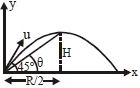
Two particles $A$ and $B$ are projected simultaneously from a fixed point of the ground. Particle $A$ is projected on a smooth horizontal surface with speed $v$, while particle $B$ is projected in air with speed $\frac{2 v}{\sqrt{3}}$. If particle $B$ hits the particle $A$, the angle of projection of $B$ with the vertical is
  • A
    $30$
  • $60$
  • C
    $45$
  • D
    Both $(a)$ and $(b)$

Answer

Correct option: B.
$60$
b
(b)

Their horizontal components should be same.

$\therefore \quad \frac{2 v}{\sqrt{3}} \cdot \cos \theta=v$

or $\theta=60^{\circ}$

Need a full question paper?

Generate a complete, print-ready paper with questions like this in minutes — across 16+ boards, with answer keys.

Start Generating Free

Similar questions

Let $A$ and $B$ the two gases and given : $\frac{{{T_A}}}{{{M_A}}} = 4.\frac{{{T_B}}}{{{M_B}}};$ where $T$ is the temperature and M is molecular mass. If ${C_A}$ and ${C_B}$ are the $r.m.s. $ speed, then the ratio $\frac{{{C_A}}}{{{C_B}}}$ will be equal to
Liquids have:
A light rod of length $l$ has two masses $m_1$ and $m_2$ attached to its two ends. The moment of inertia of the system about an axis perpendicular to the rod and passing through the centre of mass is 
Two bodies performing $SHM$ have same amplitude and frequency. Their phases at a certain instant are as shown in the figure. The phase difference between them is
A car is moving along a straight line, say $OP$ in given figure. It moves from $O$ to $P$ in $18\; s$ and returns from $P$ to $\mathrm{Q}$ in $6.0\; s$. What are the average velocity and average speed of the car in going from $O$ to $P$?
A particle is projected with velocity $v_{0}$ along $x-$ axis. A damping force is acting on the particle which is proportional to the square of the distance from the origin i.e., $ma =-\alpha x ^{2}.$ The distance at which the particle stops:
In stationary wave
A force of ${10^3}$ newton stretches the length of a hanging wire by $1$ millimetre. The force required to stretch a wire of same material and length but having four times the diameter by $1$ millimetre is
The escape velocity for a body of mass $1\, kg$ from the earth surface is $11.2\,\,km{s^{ - 1}}.$ The escape velocity for a body of mass $100\, kg$ would be
$Assertion :$ The change in air pressure affects the speed of sound.
$Reason :$ The speed of sound in gases is proportional to the square of pressure.