Question
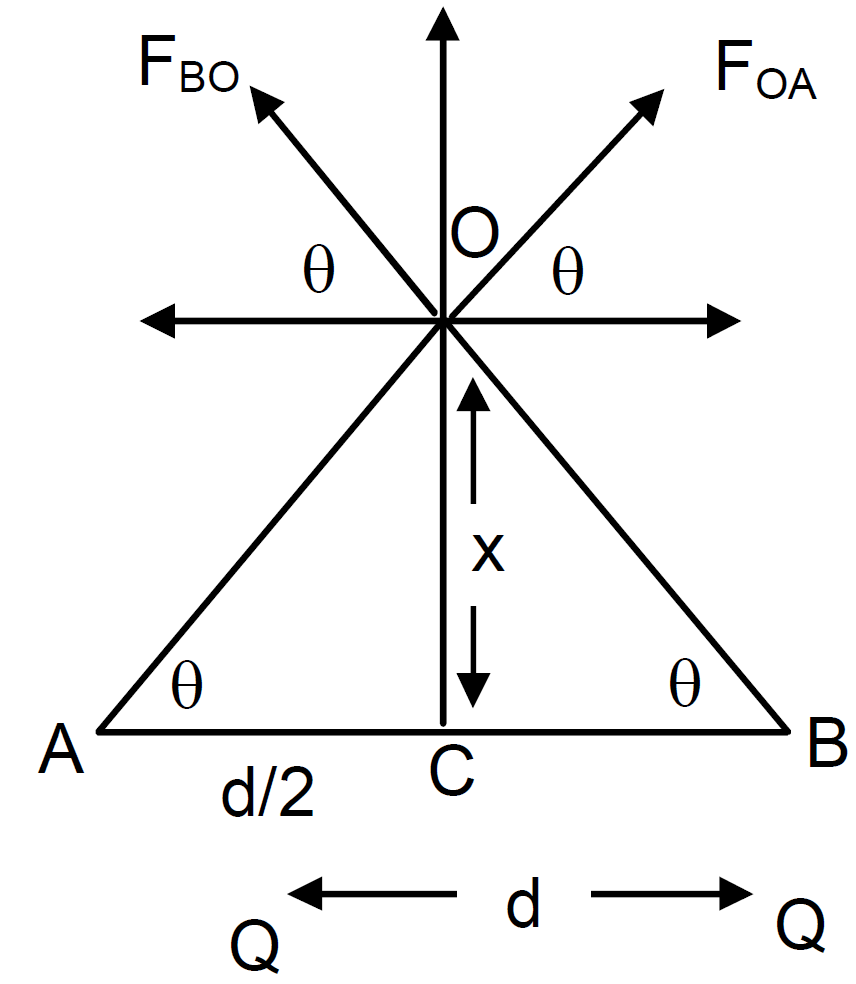
Two particles A and B, each carrying a charge Q, are held fixed with a separation d between them. A particle C having mass m and charge q is kept at the middle point of the line AB.
  1. If it is displaced through a distance x perpendicular to AB, what would be the electric force experienced by it.
  2. Assuming x << d, show that this force is proportional to x.
  3. Under what conditions will the particle C execute simple harmonic motion if it is released after such a small displacement?
Find the time period of the oscillations if these conditions are satisfied.

Answer


  1. Let Q = charge on A & B Separated by distance d
q = charge on c displaced $\bot$ to -AB
So, force on $0=\overline{\text{F}}_\text{AB}+\overline{\text{F}}_\text{BO}$
But $\text{F}_\text{AO}\cos\theta=\text{F}_\text{BO}\cos\theta$
So, force on ‘0’ in due to vertical component.
$\overline{\text{F}}=\text{F}_\text{AO}\sin\theta+\text{F}_\text{BO}\sin\theta$ $|\text{F}_\text{AO}|=|\text{F}_\text{BO}|$
$=2\frac{\text{KQq}}{\Big(\frac{\text{d}}{2^2+\text{x}^2}\big)}\sin\theta$
$\text{F}=\frac{2\text{KQq}}{\Big(\frac{\text{d}}{2}\Big)^2+\text{x}^2}\sin\theta$
$=\frac{4\times2\times2\text{KQq}}{(\text{d}^2+4\text{x}^2)}\times\frac{\text{x}}{\Big[\big(\frac{\text{d}}{2}\big)^2+\text{x}^2\Big]^{\frac{1}{2}}}$
$=\frac{2\text{kQq}}{\Big[\big(\frac{\text{d}}{2}\big)^2+\text{x}^2\Big]^{\frac{3}{2}}}\text{x}$ = Electric force $\Rightarrow\text{F}\propto\text{x}$
  1. When x << d
$\text{F}=\frac{2\text{kQq}}{\Big[\big(\frac{\text{d}}{2}\big)^2+\text{x}^2\Big]^{\frac{3}{2}}}\text{x}$ x << d
$\Rightarrow\text{F}=\frac{2\text{kQq}}{\Big(\frac{\text{d}^2}{4}\Big)^{\frac{3}{2}}}\text{x}\Rightarrow\text{F}\propto\text{x}$
$\text{a}=\frac{\text{F}}{\text{m}}=\frac{1}{\text{m}}\Bigg[\frac{2\text{kQqx}}{\Big[\big(\frac{\text{d}^2}{4}\big)+\ell^2}\Bigg]$
So time period $\text{T}=2\pi\sqrt{\frac{\ell}{\text{g}}}$
$=2\pi\sqrt{\frac{\ell}{\text{a}}}$

Need a full question paper?

Generate a complete, print-ready paper with questions like this in minutes — across 16+ boards, with answer keys.

Start Generating Free

Similar questions

A bar magnet of magnetic moment m and moment of inertia I (about centre, perpendicular to length) is cut into two equal pieces, perpendicular to length. Let T be the period of oscillations of the original magnet about an axis through the mid point, perpendicular to length, in a magnetic field B. What would be the similar period T' for each piece?
Explain the experiments of Faraday and Henry for explaining and describing the phenomenon of electromagnetic induction.
Suppose that the radius of cross-section of the wire used in the previous problem is r. Find the increase in the radius of the loop if the magnetic field is switched off. Young's modulus of the material of the wire is Y.
A resistor of $400 \Omega$, an inductor of $\frac{5}{\pi} H$ and a capacitor of $\frac{50}{\pi} \mu F$ are connected in series across a source of alternating voltage of $140 \sin 100 \pi t V$. Find the voltage $($rms$)$ across the resistor, the inductor and the capacitor. Is the algebraic sum of these voltages more than the source voltage? If yes, resolve the paradox. (Given, $\sqrt{2}=1.414 ).$
Oxygen is filled in a closed metal jar of volume $1.0 \times 10^{-3}m^3$ at a pressure of $1.5 \times 10^5Pa$ and temperature $400K$ The jar has a small leak in it. The atmospheric pressure is $1.0 \times 10^5Pa$ and the atmospheric temperature is $300K$ Find the mass of the gas that leaks out by the time the pressure and the temperature inside the jar equalise with the surrounding.
A body starts slipping down an incline and moves half meter in half second. How long will it take to move the next half meter?
An electron of kinetic energy 100eV circulates in a path of radius 10cm in a magnetic field. Find the magnetic field and the number of revolutions per second made by the electron.
Suppose all the electrons of $100g$ water are lumped together to form a negatively charged particle and all the nuclei are lumped together to form a positively charged particle. If these two particles are placed $10.0\ cm$ away from each other, find the force of attraction between them. Compare it with your weight.
A $100$ turn rectangular coil $\text{ABCD} ($in $XY$ plane$)$ is hung from one arm of a balance $($Fig$). A$ mass $500g$ is added to the other arm to balance the weight of the coil. $A$ current $4.9A$ passes through the coil and a constant magnetic field of $0.2T$ acting inward $($in $xz$ plane$)$ is switched on such that only arm $CD$ of length $1\ cm$ lies in the field. How much additional mass $'m\ '$ must be added to regain the balance?
Draw a ray diagram to show the formation of real image of the same size as that of the object placed in front of a converging lens. Using this ray diagram establish the relation between u, v and f for this lens.