Question
Establish an expression for excess pressure inside a liquid and drop.
or
Find the equation of pressure difference between the two surfaces of a spherical drop. What is the difference between this and soap bubbles?
or
The pressure excess inside a liquid drop is $P =$ $\frac{2 T}{r}$ and for a soap bubble the pressure excess is $P=\frac{4 T}{r}$, Prove it.
Answer

SELF

Need a full question paper?

Generate a complete, print-ready paper with questions like this in minutes — across 16+ boards, with answer keys.

Start Generating Free

Similar questions

A book with many printing errors contains four different formulas for the displacement y of a particle undergoing a certain periodic motion:

  1. $\text{y}=\text{a}\sin2\pi\text{ t/T}$

  2. $\text{y}=\text{a}\sin \text{vt}$

  3. $\text{y}=(\text{a/T})\sin\text{t/a}$

  4. $\text{y}=(\text{a}\sqrt{2})(\sin2\pi\text{t/T}+\cos2\pi\text{t/T})$

(a = maximum displacement of the particle, v = speed of the particle. T = time-period of motion). Rule out the wrong formulas on dimensional grounds.

A calorimeter of negligible heat capacity contains 100cc of water at 40°C. The water cools to 35°C in 5 minutes. The water is now replaced by K-oil of equal volume at 40°C. Find the time taken for the temperature to become 35°C under similar conditions. Specific heat capacities of water and K-oil are 4200Jkg-1K-1 and 2100Jkg-1K-1 respectively. Density of K-oil = 800kgm3.
Glycerine flows steadily through a horizontal tube of length 1.5m and radius 1.0cm. If the amount of glycerine collected per second at one end is 4.0 × 10–3kg s–1, what is the pressure difference between the two ends of the tube? (Density of glycerine = 1.3 × 10³kg m–3 and viscosity of glycerine = 0.83 Pa). [You may also like to check if the assumption of laminar flow in the tube is correct].
In an experimental set up, the density of a small sphere is to be determined. The diameter of the small sphere is measured with the help of a screw gauge, whose pitch is 0.4mm and there are 50 divisions on the circular scale. The reading on the main scale is 2.5mm and that on the circular scale is 20 divisions. If the measured mass of the sphere has a relative error of 2%, find the relative percentage error in density.
What is Bernoulli's theory for horizontal tube?
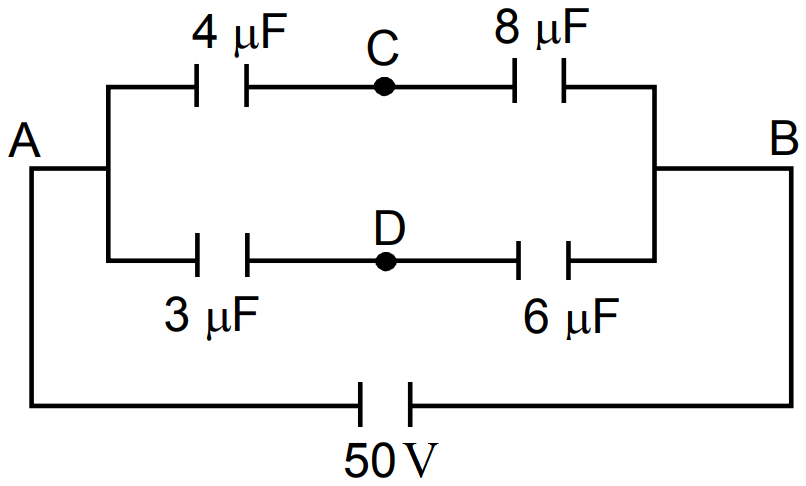
Take the potential of the point B in figure to be zero:
  1. Find the potentials at the points C and D.
  2. If a capacitor is connected between C and D, what charge will appear on this capacitor?

What are thermometer scales? How are these obtained? Find the expressions of various thermal scales and tell which of these scales is standard and explain the rason for choosing it. What is ultimate temperature?
Show that for a projectile the angle between the velocity and the x-axis as a function of time is given by,
$\theta(\text{t})=\tan^{-1}\Big(\frac{\text{u}_\text{oy}-\text{gt}}{\text{u}_\text{ox}}\Big)$
The current in a conductor and the potential difference across its ends are measured by an ammeter and a voltmeter. The meters draw negligible currents. The ammeter is accurate but the voltmeter has a zero error (that is, it does not read zero when no potential difference is applied). Calculate the zero error if the readings for two different conditions are 1.75A, 14.4V and 2.75A, 22.4V.
An isolated particle of mass m is moving in a horizontal plane (x - y), along the x-axis at a certain height about the ground. It explodes suddenly into two fragments of masses $\frac{\text{m}}{4}$ and $3\frac{\text{m}}{4}.$ An instant later, the smaller fragment is at y = + 15 cm. What is the position of larger fragment at this instant?