Question
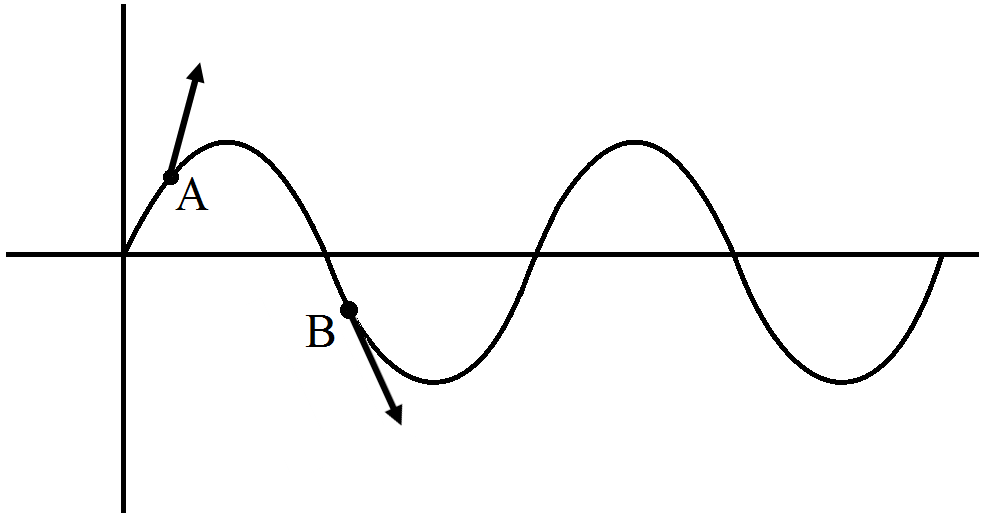
Two particles A and B have a phase difference of $\pi$ when a sine wave passes through the region.
  1. A oscillates at half the frequency of B.
  2. A and B move in opposite directions.
  3. A and B must be separated by half of the wavelength.
  4. The displacements at A and B have equal magnitudes.
Answer

  1. A and B move in opposite directions.
  1. The displacements at A and B have equal magnitudes.
Explanation:

A and Bhave a phase difference of fl. So, when a sine wave passes through the region, they move in opposite directions and have equal displacement. They may be separated by any odd multiple of their wavelength.
$\overrightarrow{\text{yA}}=\text{A}\sin(\omega\text{t})$
$\overrightarrow{\text{yB}}=\text{B}\sin(\omega\text{t}+\pi)$

Need a full question paper?

Generate a complete, print-ready paper with questions like this in minutes — across 16+ boards, with answer keys.

Start Generating Free

Similar questions

In Bohr model of hydrogen atom, let P.E. represents potential energy and T.E. represents the total energy. In going to a higher level:
In an inductor of inductance L = 100 mH, a current of I = 10A is flowing. The energy stored in the inductor is (a) 5 J(b) 10 J(c) 100 J  (d) 1000 J
       
Unit of magnetic field is :
The resistance and inductance of series circuit are $5{\Omega}$ and $20H$ respectively. At the instant of closing the switch, the current is increasing at the rate $4A - s.$ The supply voltage is
A non monochromatic light is used in an experiment on photoelectric effect. The stopping potential$:$
Two coils are at fixed locations. When coil $1$ has no current and the current in coil $2$ increases at the rate of $15.0As^{-1},$ the emf in coil $1$ is $25\ mV.$ When coil $2$ has no current and coil $1$ has a current of $3.6A,$ the flux linkage in coil $2$ is.
For a given thermocouple, the thermo e.m.f. can be(a) Zero  (b) Positive(c) Negative(d) All of the above
       
Two circuits have mutual inductance of 0.1 H. What average e.m.f. is induced in one circuit when the current in the other circuit changes from 0 to 20 A in 0.02 s(a) 240 V                                            (b) 230 V(c) 100 V(d) 300 V
       
The kinetic energy of revolving electron in hydrogen of radius ' $r$ ' will be :
Assuming that the dimmest visible star to the naked eye has a magnitude of about 6. Brightness of planet Venus (magnitude = – 4) w.r.t. this star is(a) 10,000 times brighter(b) 2000 times brighter(c) 15000 times brighter(d) 4000 times brighter