Question
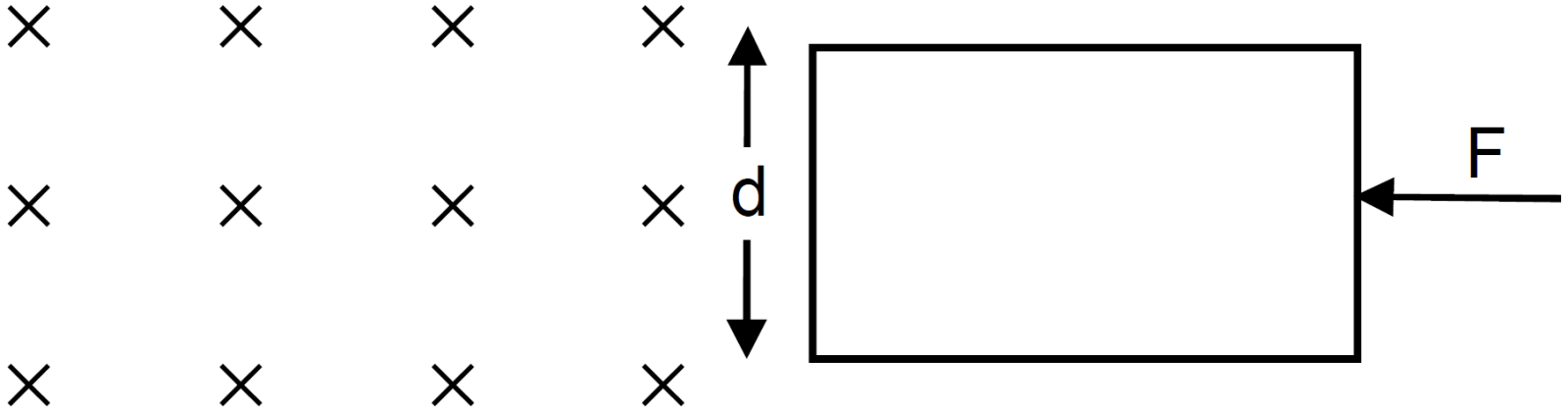
The rectangular wire-frame, shown in figure, has a width $d$, mass m, resistance $R$ and a large length. A uniform magnetic field $B$ exists to the left of the frame. A constant force $F$ starts pushing the frame into the magnetic field at $t = 0.$
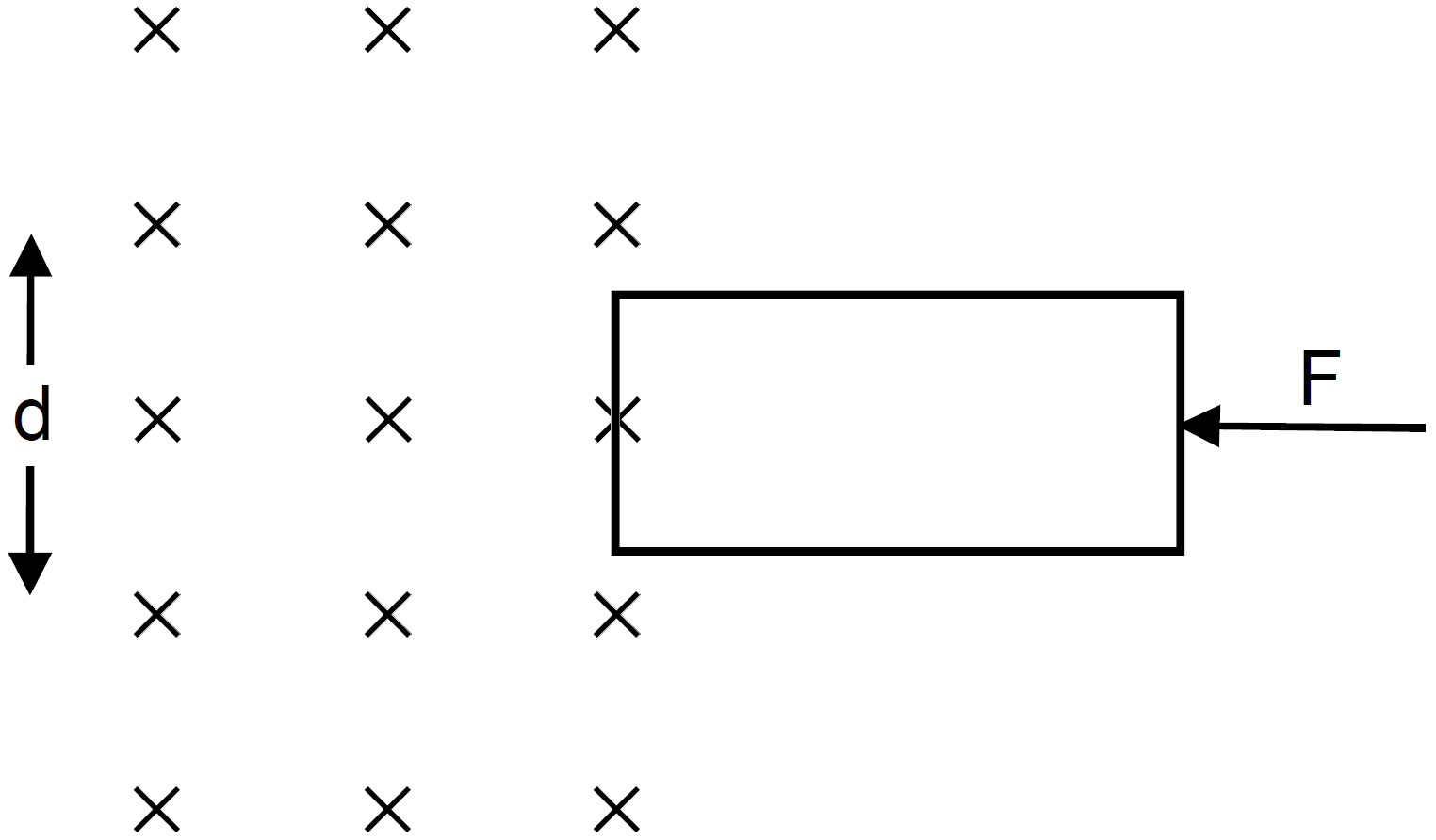
  1. Find the acceleration of the frame when its speed has increased to $v.$
  2. Show that after some time the frame will move with a constant velocity till the whole frame enters into the magnetic field. Find this velocity $v_0.$
  3. Show that the velocity at time t is given by $\text{v}=\text{v}_0\Big(1-\text{e}^{-\frac{\text{ft}}{\text{mv}_0}}\Big)$
Answer

  1. emf developed $= Bdv ($when it attains a speed $v)$
Current $=\frac{\text{Bdv}}{\text{R}}$
Force $=\frac{\text{B}\text{d}^2\text{v}^2}{\text{R}}$
This force opposes the given force
Net F $=\text{F}-\frac{\text{B}\text{d}^2\text{v}^2}{\text{R}}=\text{RF}-\frac{\text{B}\text{d}^2\text{v}^2}{\text{R}}$
Net acceleration $=\frac{\text{RF}-\text{B}^2\text{d}^2\text{v}}{\text{mR}}$
  1. Velocity becomes constant when acceleration is $0.$
$\frac{\text{F}}{\text{m}}-\frac{\text{B}^2\text{d}^2\text{v}_0}{\text{mR}}=0$
$\Rightarrow\frac{\text{F}}{\text{m}}=\frac{\text{B}^2\text{d}^2\text{v}_0}{\text{mR}}$
$\Rightarrow\text{v}_0=\frac{\text{FR}}{\text{B}^2\text{d}^2}$
  1. Velocity at line $t$
$\text{a}=-\frac{\text{dv}}{\text{dt}}$
$\Rightarrow\int_{0}^{\text{v}}\frac{\text{dv}}{\text{RF}-\text{l}^2\text{B}^2\text{v}}=\int_{0}^{\text{t}}\frac{\text{dt}}{\text{mR}}$
$\Rightarrow\Big[\text{l}_\text{n}\big[\text{RF}-\text{l}^2\text{B}^2\text{v}\big]\frac{1}{-\text{l}^2\text{B}^2}\Big]_0^{\text{v}} \ \Big[\frac{\text{t}}{\text{Rm}}\Big]_0^{\text{t}} $
$\Rightarrow\Big[\text{l}_\text{n}\big(\text{RF}-\text{l}^2\text{B}^2\text{v}\big)\Big]_{0}^{\text{v}}=\frac{-\text{tl}^2\text{B}^2}{\text{Rm}}$
$\Rightarrow\text{l}_\text{n}\big(\text{RF}-\text{l}^2\text{B}^2\text{v}\big)-\text{ln}(\text{RF})=\frac{-\text{t}^2\text{B}^2\text{t}}{\text{Rm}}$
$\Rightarrow1-\frac{\text{l}^2\text{B}^2\text{v}}{\text{Rf}}=\text{e}^{\frac {-\text{l}^2\text{B}^2\text{t}}{\text{Rm}}}$
$\Rightarrow\frac{\text{l}^2\text{B}^2\text{v}}{\text{Rf}}=1-\text{e}^{\frac {-\text{l}^2\text{B}^2\text{t}}{\text{Rm}}}$
$\Rightarrow\text{v}=\frac{\text{FR}}{\text{l}^2\text{B}^2}\Big(1-\text{e}^{\frac{-\text{l}^2\text{B}^2\text{v}_0\text{t}}{\text{Rv}_0\text{m}}}\Big)=\text{v}_0(1-\text{e}^{-\text{Fv}_0\text{m}})$

Need a full question paper?

Generate a complete, print-ready paper with questions like this in minutes — across 16+ boards, with answer keys.

Start Generating Free

Similar questions

A card sheet divided into squares each of size $1 \ mm^2$ is being viewed at a distance of $9 \ cm$ through a magnifying glass $(a$ converging lens of focal length $9 \ cm)$ held close to the eye.
  1. What is the magnification produced by the lens ? How much is the area of each square in the virtual image?
  2. What is the angular magnification (magnifying power) of the lens?
  3. Is the magnification in $(a)$ equal to the magnifying power in $(b)$? Explain.
A given coin has a mass of $3.0\ g$. Calculate the nuclear energy that would be required to separate all the neutrons and protons from each other. For simplicity assume that the coin is entirely made of $^{63}_{29}\text{Cu}$ atoms $($of mass $62.92960 u).$
Quite often, connecting wires carrying currents in opposite directions are twisted together in using electrical appliances. Explain how it avoids unwanted magnetic fields.
Consider a thin target $(10^{-2}m^2 ,  10^{-3}m$ thickness$)$ of sodium, which produces a photocurrent of $100\mu A$ when a light of intensity $100W/m^2 (\lambda = 660nm)$ falls on it. Find the probability that a photoelectron is produced when a photons strikes a sodium atom. $[$Take density of Na $= 0.97 \ kg/m^3].$
Give the shape of interference fringes observed
a. in a Young's double-slit experiment
b. in the air wedge experiment
c. in the Lloyd's mirror experiment
d. when a small lamp is placed before a thin mica sheet and light waves reflected from the front and back surfaces of the sheet combine to produce interference pattern on a screen behind the lamp. (Pohl's experiment)
e. from a thin air film formed by placing a convex lens on top of a flat glass plate (Newton's arrangement).
Two charges -q each are separated by distance 2d. A third charge +q is kept at mid point O. Find potential energy of +q as a function of small distance x from O due to -q charges. Sketch P.E. v/s x and convince yourself that the charge at O is in an unstable equilibrium.
Verify the Gauss’s law for magnetic field of a point dipole of dipole moment m at the origin for the surface which is a sphere of radius R.
Assume that a tunnel is dug across the earth $($radius $= R)$ passing through its centre. Find the time a particle takes to cover the length of the tunnel if,
  1. It is projected into the tunnel with a speed of $\sqrt{\text{gR}}.$
  2. It is released from a height $R$ above the tunnel.
  3. It is thrown vertically upward along the length of tunnel with a speed of $\sqrt{\text{gR}}.$
A stone is thrown vertically upward with a speed of $28m/s.$
  1. Find the maximum height reached by the stone.
  2. Find its velocity one second before it reaches the maximum height.
  3. Does the answer of part.
  4. Change if the initial speed is more than $28m/s$ suchas $40m/s$ or $80m/s$?
A professor reads a greeting card received on his 50th birthday with +2.5D glasses keeping the card 25cm away. Ten years later, he reads his farewell letter with the same glasses but he has to keep the letter 50cm away. What power of lens should he now use?