Question
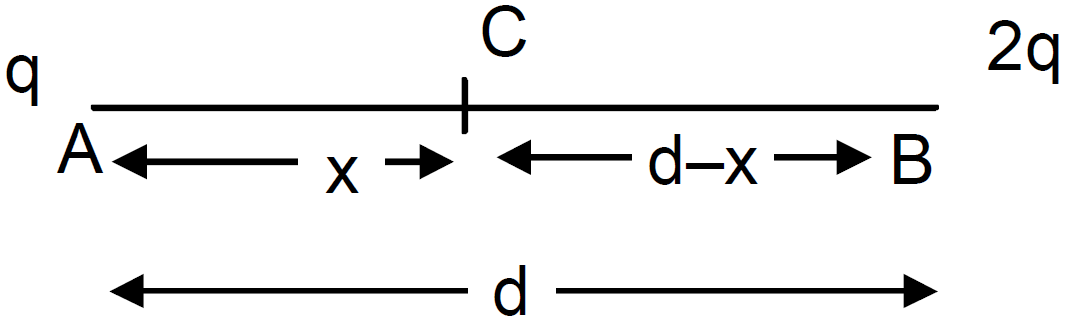
Two particles A and B having charges q and 2q respectively are placed on a smooth table with a separation d. A third particle C is to be clamped on the table in such a way that the particles A and B remain at rest on the table under electrical forces. What should be the charge on C and where should it be clamped?
Answer


Let the charge on C = q
So, net force on c is equal to zero
So, $\text{F}_{\overline{\text{AC}}}+\text{F}_{\overline{\text{BA}}}=0,$
But $\text{F}_{\overline{\text{AC}}}=\text{F}_{\overline{\text{BC}}}$
$\Rightarrow\frac{\text{kqQ}}{\text{x}^2}=\frac{\text{k}2\text{qQ}}{(\text{d}-\text{x})^2}$
$\Rightarrow2\text{x}^2=(\text{d}-\text{x})^2$
$\Rightarrow\sqrt{2}\text{x}=\text{d}-\text{x}$
$\Rightarrow\text{x}=\frac{\text{d}}{\sqrt{2}+1}$
$=\frac{\text{d}}{\big(\sqrt{2}+1\big)}\times\frac{\big(\sqrt{2}-1\big)}{\big(\sqrt{2}-1\big)}$
$=\text{d}\big(\sqrt{2}-1\big)$
For the charge on rest, $\text{F}_\text{AC}+\text{F}_\text{AB}=0$
$(2.414)^2\frac{\text{kqQ}}{\text{d}^2}+\frac{\text{kq}(2\text{q})}{\text{d}^2}=0$
$\Rightarrow\frac{\text{kq}}{\text{d}^2}\big[(2.414)^2\text{Q}+2\text{q}\big]=0$
$\Rightarrow2\text{q}=-(2.414)^2\text{Q}$
$\Rightarrow\text{Q}=\frac{2}{-\big(\sqrt{2}+1\big)^2}\text{q}$
$=-\Big(\frac{2}{3+2\sqrt{2}}\Big)\text{q}$
$=-(0.343)\text{q}$
$=-\big(6-4\sqrt{2}\big)$

Need a full question paper?

Generate a complete, print-ready paper with questions like this in minutes — across 16+ boards, with answer keys.

Start Generating Free

Similar questions

Define elastic and inelastic collisions. Write their basic characteristics. A bullet is fired into a block of wood. If it gets totally embedded in it and the system moves together as one entity, then state what happens to the initial kinetic energy and linear momentum of the bullet?
  1. Show that the pressure exerted by a liquid column is proportional to its height.
  2. State Pascal's law.
A pendulum clock gives correct time. What is the error in time per day if the length increases by 0.05%?
A body describes simple harmonic motion with an amplitude of 5cm and a period of 0.2s. Find the acceleration and velocity of the body when the displacement is (a) 5cm (b) 3cm (c) 0cm.
Find the time period of the motion of the particle shown in figure Neglect the small effect of the bend near the bottom.
The displacement of an elastic wave is given by the function $\text{y}=3\sin\omega\text{t}+4\cos\omega\text{t}$ where y is in cm and t is in second. Calculate the resultant amplitude.
Find the component of $\vec{\text{a}}=2\hat{\text{i}}+3\hat{\text{j}}$ along the directions of vectors $\hat{\text{i}}+\hat{\text{j}}$ and $\hat{\text{i}}-\hat{\text{j}}.$
A ball falls on an inclined plane of inclination $\theta$ from a height h above the point of impact and makes a perfectly elastic collision. Where will it hit the plane again?
A particle P starts its motion at t = 0 and moves along a circle as shown in figure with period of 4s. Write down the equation representing S.H.M. of the particle P.
Explain the difference between harmonic motion and simple harmonic motion. Explain the characteristics and types of simple harmonic motion. Also write differential equations with examples.