Question
Define elastic and inelastic collisions. Write their basic characteristics. A bullet is fired into a block of wood. If it gets totally embedded in it and the system moves together as one entity, then state what happens to the initial kinetic energy and linear momentum of the bullet?
Answer

Elastic collision: A collision in which there is absolutely no loss of kinetic energy is called elastic collision. Characteristics :
  1. The linear momentum is conserved.
  2. Total energy of system is conserved.
  3. Kinetic energy is conserved.
  4. Forces involved during elastic collisions must be conservative forces.
Inelastic collision: A collision in which there occurs some loss of kinetic energy is called inelastic collision.Characteristics :
  1. Linear momentum is conserved.
  2. Total energy is conserved.
  3. $K.E.$ is not conserved.
  4. Some or all forces involved may be non$-$conservative.
Consider two particles $A$ and $B$ of masses $m_1$ and $m_2$ moving with initial velocities $u_1$ and $u_2$ along $x-$axis.
They collide and move as one entity.
Let $V$ be the common velocity when they move as single mass.
$m_1 =$ Mass of bullet $u_1 =$ Initial velocity of bullet $m_2 =$ Mass of wood.
$u_2 =$ Initial velocity of wood $= 0$ According to conservation of momentum.
$m_1u_1+ m_2 u_2 = ( m_1 + m_2 )V u_2 = 0$
$\text{V}=\frac{\text{m}_1\text{u}_2}{\text{m}_1+\text{m}_2}\cdots{\text{i}}$
Initial $K.E, \text{k}_\text{i}\frac{1}{2}\text{m}_1\text{u}_1^2$
Final $K.E., \text{k}_\text{f}=\frac{1}{2}(\text{m}_1+\text{m}_2)\text{V}^2$
$\frac{\text{K}_\text{f}}{\text{K}_\text{i}}=\frac{\frac{1}{2}(\text{m}_1+\text{m}_2)\text{V}^2}{\frac{1}{2}\text{m}_1\text{u}_1^2}$
$=\Big(\frac{\text{m}_1+\text{m}_2}{\text{m}_1}\Big)\frac{\text{V}^2}{\text{u}_1^2}\ \cdots\text{(ii)}$
From $(i)$ and $(ii) \frac{\text{K}_\text{f}}{\text{K}_\text{i}}=\Big(\frac{\text{m}_1\text{m}_2}{\text{m}_1}\Big)\Big(\frac{\text{m}_1}{\text{m}_1+\text{m}_2}\Big)^2$
$=\frac{\text{m}_1}{\text{m}_1+\text{m}_2}$ When, $\text{K}_\text{f}<\text{K}_\text{i}$ there is loss in $K.E.$

Need a full question paper?

Generate a complete, print-ready paper with questions like this in minutes — across 16+ boards, with answer keys.

Start Generating Free

Similar questions

Two particles each of mass m and speed v travel in opposite direction along parallel lines, separated by a distance d. Show that vector angular momentum of the two particles system is same whatever be the point about which angular momentum is taken.
The two blocks in an Atwood machine have masses $2.0kg$ and $3.0kg$. Find the work done by gravity during the fourth second after the system is released from rest.
  1. What is the largest average velocity of blood flow in an artery of radius $2×10 – 3m$ if the flow must remain lanimar?
  2. What is the corresponding flow rate ? (Take viscosity of blood to be $2.084 × 10⁻³ Pa/ s$).
An electron of kinetic energy 100eV circulates in a path of radius 10cm in a magnetic field. Find the magnetic field and the number of revolutions per second made by the electron.
A train, standing at the outer signal of a railway station blows a whistle of frequency $400Hz$ in still air.
  1. What is the frequency of the whistle for a platform observer when the train (a) approaches the platform with a speed of $10m s^{–1}$, (b) recedes from the platform with a speed of $10m s^{–1}$?
  2. What is the speed of sound in each case? The speed of sound in still air can be taken as $340m s^{–1}$.
Two lead spheres of 20cm and 2cm diameter respectively are placed with centres 100cm apart. Calculate the attraction between them, given the radius of the earth as $6.37 \times 10^8cm$ and its mean density as $5.53 \times 103kgm^{-3}$, specific gravity of lead = 11.5. If the lead spheres are replaced by brass spheres of the same radii, would the force of attraction be the same?
A light beam of wavelength $400$ run is incident on a metal plate of work function $2.2eV$.
  1. A particular electron absorbs a photon and makes two collisions before coming out of the metal. Assuming that $10\%$ of the extra energy is lost to the metal in each collision, find the kinetic energy of this electron as it comes out of the metal.
  2. Under the same assumptions, find the maximum number of collisions the electron can suffer before it becomes unable to come out of the metal.
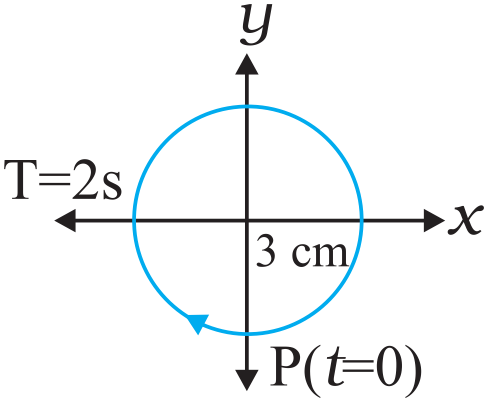
Figures correspond to two circular motions. The radius of the circle, the period of revolution, the initial position, and the sense of revolution (i.e. clockwise or anti-clockwise) are indicated on each figure.

Obtain the corresponding simple harmonic motions of the x-projection of the radius vector of the revolving particle P, in each case.
A body of mass 2kg is lying on a rough inclined plane of inclination 30°. Find the magnitude of the force parallel to the incline needed to make the block move:
  1. Up the incline
  2. Down the incline. Coefficient of static friction = 0.2.
If the nucleons of a nucleus are separated from each other, the total mass is increased. Where does this mass come from?