Two particles are in $SHM$ in a straight line. Amplitude $A$ and time period $T$ of both the particles are equal. At time $t=0,$ one particle is at displacement $y_1= +A$ and the other at $y_2= -A/2,$ and they are approaching towards each other. After what time they cross each other ?
Advanced
Download our app for free and get started
Angle covered to meet $\theta=60^{\circ}=\frac{\pi}{3} \mathrm{rad}$
If they cross each other at time $t$ then
$\mathrm{t}=\frac{\theta}{2 \pi}=\frac{\pi}{3 \times 2 \pi} \mathrm{T}=\frac{\mathrm{T}}{6}$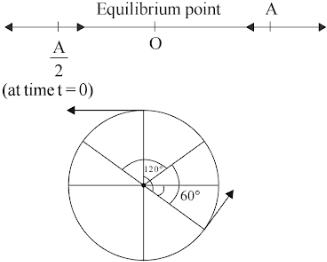

Download our appand get started for free
Experience the future of education. Simply download our apps or reach out to us for more information. Let's shape the future of learning together!No signup needed.*
Similar Questions
- 1A particle executes $SHM $ in a line $4\, cm $ long. Its velocity when passing through the centre of line is $12\, cm/s$. The period will be ..... $s$View Solution
- 2A particle of mass $m$ is attached to three identical springs $A, B$ and $C$ each of force constant $ k$ a shown in figure. If the particle of mass $m$ is pushed slightly against the spring $A$ and released then the time period of oscillations isView Solution
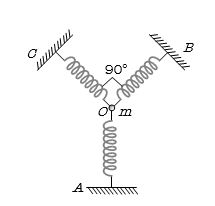
- 3A particle is executing the motion $x = A\cos (\omega \,t - \theta )$. The maximum velocity of the particle isView Solution
- 4A body is in simple harmonic motion with time period half second $(T\, = 0.5\, s)$ and amplitude one $cm\, (A\,= 1\, cm)$. Find the average velocity in the interval in which it moves form equilibrium position to half of its amplitude .... $cm/s$View Solution
- 5Two masses $m_1$ and $m_2$ are supended together by a massless spring of constant $k$. When the masses are in equilibrium, $m_1$ is removed without disturbing the system; the amplitude of vibration isView Solution
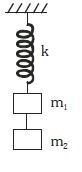
- 6The $x$-t graph of a particle undergoing simple harmonic motion is shown below. The acceleration of the particle at $t=4 / 3 \mathrm{~s}$ isView Solution
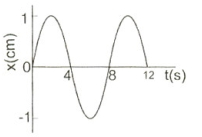
- 7View SolutionIn a simple harmonic oscillator, at the mean position
- 8What is the velocity of the bob of a simple pendulum at its mean position, if it is able to rise to vertical height of $10cm$ ......... $m/s$ (Take $g = 9.8\,m/{s^2})$View Solution
- 9The displacement time graph of a particle executing $S.H.M.$ is as shown in the figureThe corresponding force-time graph of the particle isView Solution
- 10A $1.00 \times {10^{ - 20}}kg$ particle is vibrating with simple harmonic motion with a period of $1.00 \times {10^{ - 5}}sec$ and a maximum speed of $1.00 \times {10^3}m/s$. The maximum displacement of the particle isView Solution