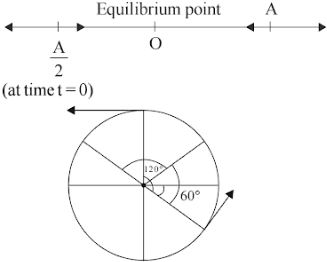
Two particles are in $SHM$ in a straight line. Amplitude $A$ and time period $T$ of both the particles are equal. At time $t=0,$ one particle is at displacement $y_1= +A$ and the other at $y_2= -A/2,$ and they are approaching towards each other. After what time they cross each other ?
Advanced


Download our appand get started for free
Experience the future of education. Simply download our apps or reach out to us for more information. Let's shape the future of learning together!No signup needed.*
Similar Questions
- 1Two springs have spring constants ${K_A}$ and ${K_B}$ and ${K_A} > {K_B}$. The work required to stretch them by same extension will beView Solution
- 2A simple pendulum consisting of a light inextensible string of length $\ell$ attached to a heavy small bob of mass $m$ is at rest. The bob is imparted a horizontal impulsive force which gives it a speed of $\sqrt{4 g \ell}$. The speed of the bob at its highest point is ( $g$ is the accelaration due to gravity)View Solution
- 3The length of a spring is $l$ and its force constant is $k$. When a weight $W$ is suspended from it, its length increases by $x$. If the spring is cut into two equal parts and put in parallel and the same weight $W$ is suspended from them, then the extension will beView Solution
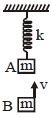
- 4Block $A$ is hanging from a vertical spring and it is at rest. Block $'B'$ strikes the block $'A'$ with velocity $v$ and stick to it. Then the velocity $v$ for which the spring just attains natural length is:View Solution
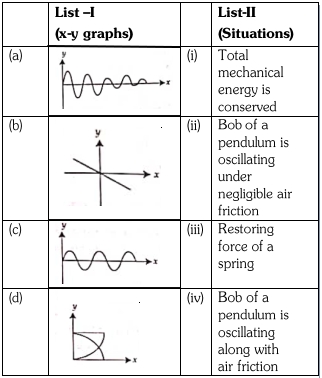
- 5Match $List - I$ with $List - II$View Solution
Choose the correct answer from the options given below
- 6The motion of a particle executing $S.H.M.$ is given by $x = 0.01\sin 100\pi (t + .05)$, where $x$ is in metres and time is in seconds. The time period is ..... $\sec$View Solution
- 7The amplitude and the time period in a $S.H.M.$ is $0.5 \,cm$ and $0.4 \,sec$ respectively. If the initial phase is $\pi /2$ radian, then the equation of $S.H.M.$ will beView Solution
- 8A spring whose unstretched length is $\ell $ has a force constant $k$. The spring is cut into two pieces of unstretched lengths $\ell_1$ and $\ell_2$ where, $\ell_1 = n\ell_2$ and $n$ is an integer. The ratio $k_1/k_2$ of the corresponding force constants, $k_1$ and $k_2$ will beView Solution
- 9There is a simple pendulum hanging from the ceiling of a lift. When the lift is stand still, the time period of the pendulum is $T$. If the resultant acceleration becomes $g/4,$ then the new time period of the pendulum isView Solution
- 10If particle is executing simple harmonic motion with time period $T$, then the time period of its total mechanical energy is ...........View Solution