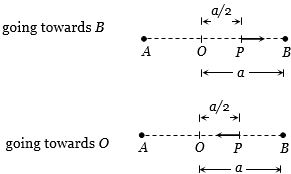
Two particles are oscillating along two close parallel straight lines side by side, with the same frequency and amplitudes. They pass each other, moving in opposite directions when their displacement is half of the amplitude. The mean positions of the two particles lie on a straight line perpendicular to the paths of the two particles. The phase difference is
  • A$\pi$
  • B$\frac{\pi}{6}$
  • C$0$
  • D$\frac{2 \pi}{3}$
AIPMT 2011, Diffcult
art

Download our app
and get started for free

Experience the future of education. Simply download our apps or reach out to us for more information. Let's shape the future of learning together!No signup needed.*

Similar Questions

  • 1
    A particle moves in $xy$ plane according to the law $x = a \sin \omega t$ and $y = a(1-\cos \omega t)$ where $a$ and $\omega$ are constants. The particle traces
    View Solution
  • 2
    The metallic bob of simple pendulum has the relative density $5$. The time period of this pendulum is $10\,s$. If the metallic bob is immersed in water, then the new time period becomes $5 \sqrt{ x } s$. The value of $x$ will be.
    View Solution
  • 3
    A simple pendulum with a bob of mass $‘m’$ oscillates from $A$ to $ C$ and back to $A$ such that $PB$ is $H.$ If the acceleration due to gravity is $‘g’$, then the velocity of the bob as it passes through $B$ is
    View Solution
  • 4
    A block is resting on a piston which executes simple harmonic motion with a period $2.0 \,s$. The maximum velocity of the piston, at an amplitude just sufficient for the block to separate from the piston is .......... $ms ^{-1}$
    View Solution
  • 5
    A particle with restoring force proportional to displacement and resisting force proportional to velocity is subjected to a force $F\sin \omega t$. If the amplitude of the particle is maximum for $\omega = {\omega _1}$ and the energy of the particle is maximum for $\omega = {\omega _2}$, then (where ${\omega _0}$ natural frequency of oscillation of particle)
    View Solution
  • 6
    Identify the function which represents a periodic motion.
    View Solution
  • 7
    For a body executing $S.H.M. :$

    $(a)$ Potential energy is always equal to its $K.E.$

    $(b)$ Average potential and kinetic energy over any given time interval are always equal.

    $(c)$ Sum of the kinetic and potential energy at any point of time is constant.

    $(d)$ Average $K.E.$ in one time period is equal to average potential energy in one time period.

    Choose the most appropriate option from the options given below:

    View Solution
  • 8
    A particle executes linear simple harmonic motion with an ampilitude of $3\,cm$ . When the particle is at $2\,cm$ from the mean position , the magnitude of its velocity is equal to that of its acceleration. Then its time period in seconds is 
    View Solution
  • 9
    A light balloon filled with helium of density $\rho_{ He }$ is tied to a long light string of length $l$ and the string is attached to the ground. If the balloon is displaced slightly in the horizontal direction from the equilibrium and released. Then,
    View Solution
  • 10
    Two masses $M_{A}$ and $M_{B}$ are hung from two strings of length $l_{A}$ and $l_{B}$ respectively. They are executing SHM with frequency relation $f_{A}=2 f_{B}$, then relation
    View Solution