MCQ
Two particles executing $S.H.M.$ of same frequency, meet at $x=+A / 2$, while moving in opposite directions. Phase difference between the particles is .........
  • A
    $\frac{\pi}{6}$
  • B
    $\frac{\pi}{3}$
  • C
    $\frac{5 \pi}{6}$
  • $\frac{2 \pi}{3}$

Answer

Correct option: D.
$\frac{2 \pi}{3}$
d
(d)

$x=A \sin \omega t$

When displacement

$x=\frac{A}{2}$

$\frac{A}{2}=A \sin (\omega t+\phi)$

$\sin ^{-1} \frac{1}{2}=\omega t+\phi$

$\omega t+\phi=30^{\circ} \text { or } 150^{\circ}$

When particles are in opposite direction at one lime phase is $30^{\circ}$ and at the other $150^{\circ}$. So phase difference is $120^{\circ}$.

Need a full question paper?

Generate a complete, print-ready paper with questions like this in minutes — across 16+ boards, with answer keys.
Start Generating Free

Similar questions

A mass $M$ is suspended from a spring of negligible mass. The spring is pulled a little and then released so that the mass executes $S.H.M.$ of time period $T$. If the mass is increased by m, the time period becomes $5T/3$. Then the ratio of $m/M$ is
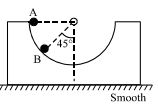
Aball of mass $m$ is released from Ainside $a$ smooth wedge of mass $m$ as shown in the figure. What is the speed of the wedge when the ball reaches point $B$ ?
A ball is rolled off the edge of a horizontal table at a speed of $4\, m/second$. It hits the ground after $0.4\, second$. Which statement given below is true
For the four sets of three measured physical quantities as given below. Which of the following options is correct ?

$(i)$ $\mathrm{A}_{1}=24.36, \mathrm{B}_{1}=0.0724, \mathrm{C}_{1}=256.2$

$(ii)$ $\mathrm{A}_{2}=24.44, \mathrm{B}_{2}=16.082, \mathrm{C}_{2}=240.2$

$(iii)$ $\mathrm{A}_{3}=25.2, \mathrm{B}_{3}=19.2812, \mathrm{C}_{3}=236.183$

$(iv)$ $\mathrm{A}_{4}=25, \mathrm{B}_{4}=236.191, \mathrm{C}_{4}=19.5$

For a particle performing uniform circular motion, choose the correct statement$(s)$ from the following:
  1. Magnitude of particle velocity $($speed$)$ remains constant.
  2. Particle velocity remains directed perpendicular to radius vector.
  3. Direction of acceleration keeps changing as particle moves.
  4. Angular momentum is constant in magnitude but direction keeps changing.
The earth, moving around the sun in a circular orbit, is acted upon by a force and hence work done on the earth by the force is:
Energy of $10$ non rigid diatomic molecules at temperature $\mathrm{T}$ is :
The ratio of radii of two wires of same material is $2: 1$. If these wires are stretched by equal force, the ratio of stresses produced in them is .............
A cylinder contains $10\, kg$ of gas at pressure of ${10^7}\,\,N/{m^2}.$ The quantity of gas taken out of the cylinder, if final pressure is $2.5 \times {10^6}\,N/{m^2},$ will be ..... $kg$ (Temperature of gas is constant)
The net applied force on a body in uniform circular motion should always be