MCQ
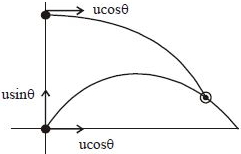
Two particles in same vertical plane are thrown to strike at same time. One from ground and other from height $h$ vertically above it. Ground particle is thrown obliquly and it achives a maximum height $H$. The second particle is thrown horizontally with same speed. What can be maximum $h$ so that two particles strike in air.
  • A
    $H$
  • B
    $2H$
  • C
    $3H$
  • $4H$

Answer

Correct option: D.
$4H$
d
$\frac{\mathrm{h}}{\mathrm{u} \sin \theta} \leq \frac{2 \mathrm{u} \sin \theta}{\mathrm{g}} \Rightarrow \mathrm{h} \leq \frac{2 \mathrm{u}^{2} \sin ^{2} \theta}{\mathrm{g}}=4 \mathrm{H}$

Need a full question paper?

Generate a complete, print-ready paper with questions like this in minutes — across 16+ boards, with answer keys.

Start Generating Free

Similar questions

A wide vessel with a small hole at the bottom is filled with two liquids. The density and heightof one liquid are $\rho_1$ and $h_1$ and that of the otherare  $\rho_2$ and $h_2 \ (\rho_1 >\rho_2)$. The velocity of liquid coming out of the hole is :
The value of Stefan’s constant is
A batsman deflects a ball by an angle of $45^o$ without changing its initial speed which is equal to $54\; km/h$. What is the impulse imparted to the ball in $kg\;m/s$? (Mass of the ball is $0.15 \;kg.)$
A $2 \mathrm{~kg}$ brick begins to slide over a surface which is inclined at an angle of $45^{\circ}$ with respect to horizontal axis. The co-efficient of static friction between their surfaces is:
In a capillary tube, water rises by $1.2\, mm$. The height of water that will rise in another capillary tube having half the radius of the first, is ........ $mm$
Pressure inside a soap bubble is greater than the pressure outside by an amount :

(given : $\mathrm{R}=$ Radius of bubble, $\mathrm{S}=$ Surface tension of bubble)

$Assertion :$ Solids are least compressible and gases are most compressible.
$Reason :$ solids have definite shape and volume but gases do not have either definite shape or definite volume.
From a disc of radius $R$ and mass $M,$ a circular hole of diameter $R,$ whose rim passes through the centre is cut. What is the moment of inertia of the remaining part of the disc about a perpendicular axis, passing through the centre?
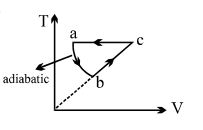
$PV$ curve for the process whose $VT$ curve is
A travelling wave represented by $y = A \sin (\omega t - kx )$ is susperimposed on another wave represented by $y = A$ $\sin (\omega t + kx )$. The resultant is