MCQ
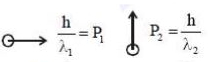
Two particles move at right angle to each other. Their de Broglie wavelengths are ${\lambda _1}$ and ${\lambda _2}$ respectively. The particles suffere perfectly inelastic collision. The de Broglie wavelength $\lambda $ , of the final particle, is given by
  • A
    $\lambda  = \sqrt {{\lambda _1}{\lambda _2}} $
  • B
    $\lambda  = \frac{{{\lambda _1} + {\lambda _2}}}{2}$
  • C
    $\frac{2}{\lambda } = \frac{1}{{{\lambda _1}}} + \frac{1}{{{\lambda _2}}}$
  • $\frac{1}{{{\lambda ^2}}} = \frac{1}{{\lambda _1^2}} + \frac{1}{{\lambda _2^2}}$
Answer

Correct option: D.
$\frac{1}{{{\lambda ^2}}} = \frac{1}{{\lambda _1^2}} + \frac{1}{{\lambda _2^2}}$
d
$\vec{P}_{1}=\frac{h}{\lambda_{1}} \hat{i}$ and $\vec{P}_{2}=\frac{h}{\lambda_{2}} \hat{j}$

Using momentum conservation

$\vec{P}=\vec{P}_{1}+\vec{P}_{2}=\frac{h}{\lambda_{1}} \hat{i}+\frac{h}{\lambda_{2}} \hat{j}$

$|\vec P| = \sqrt {{{\left( {\frac{h}{{{\lambda _1}}}} \right)}^2} + {{\left( {\frac{h}{{{\lambda _2}}}} \right)}^2}} $

$\frac{h}{\lambda}=\sqrt{\left(\frac{h}{\lambda_{1}}\right)^{2}+\left(\frac{h}{\lambda_{2}}\right)^{2}}$

$\frac{1}{\lambda^{2}}=\frac{1}{\lambda_{1}^{2}}+\frac{1}{\lambda_{2}^{2}}$

Need a full question paper?

Generate a complete, print-ready paper with questions like this in minutes — across 16+ boards, with answer keys.

Start Generating Free

Similar questions

A body of mass $m$ moving with velocity  $v$ elastic collides head on with another body of mass $2\,\,m$ which is initially at rest. The ratio of  $K.E.$  of the colliding body before and after collision will be
A $5.0\, \mu F$ capacitor is charged to a potential difference $800\, V$ and discharged through a conductor. The energy(in $J$) given to a conductor during the discharge is
The electrostatic energy of $Z$ protons uniformly distributed throughout a spherical nucleus of radius $R$ is given by

$E=\frac{3}{5} \frac{Z(Z-1) e^2}{4 \pi \varepsilon_0 R}$

The measured masses of the neutron, ${ }_1^1 \mathrm{H},{ }_7^{15} \mathrm{~N}$ and ${ }_8^{15} \mathrm{O}$ are $1.008665 \mathrm{u}, 1.007825 \mathrm{u}$, $15.000109 \mathrm{u}$ and $15.003065 \mathrm{u}$, respectively. Given that the radii of both the ${ }_7^{15} \mathrm{~N}$ and ${ }_8^{15} \mathrm{O}$ nuclei are same, $1 \mathrm{u}=931.5 \mathrm{MeV} / \mathrm{c}^2$ ( $c$ is the speed of light) and $e^2 /\left(4 \pi \varepsilon_0\right)=1.44 \mathrm{MeV} \mathrm{fm}$. Assuming that the difference between the binding energies of ${ }_7^{15} \mathrm{~N}$ and ${ }_8^{15} \mathrm{O}$ is purely due to the electrostatic energy, the radius of either of the nuclei is

$\left(1 \mathrm{fm}=10^{-15} \mathrm{~m}\right.$ )

${Image}$  The product $"P"$ in the above reaction is
Work done for the process shown in the figure is ............ $J$
If the voltage between the terminals $A$ and $B$ is $17\ V$ and zener breakdown voltage is $9\ V$ , then the potential voltage across $R$ is.......$V$
The de Broglie wavelength of an electron having kinetic energy $E$ is $\lambda$. If the kinetic energy of electron becomes $\frac{E}{4}$, then its de-Broglie wavelength will be :
A $500 \,kg$ car takes a round turn of radius $50 \,m$ with a velocity of $36 \,km/hr$. The centripetal force is ..........  $N$
A magnetic needle of magnetic moment $6.7 \times 10^{-2} $ $Am^2$ and moment of inertia $7.5 \times  10^{-6}$ $ kgm^2$ is performing simple harmonic oscillations in a magnetic field of $0.01\ T$. Time taken for $10$ complete oscillations is.....$s$
In an hydrogen atom, the electron revolves around the nucleus in an orbit of radius $0.53 \times {10^{ - 10}}\,m$. Then the electrical potential produced by the nucleus at the position of the electron is......$V$