MCQ
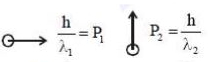
Two particles move at right angle to each other. Their de Broglie wavelengths are ${\lambda _1}$ and ${\lambda _2}$ respectively. The particles suffere perfectly inelastic collision. The de Broglie wavelength $\lambda $ , of the final particle, is given by
  • A
    $\lambda  = \sqrt {{\lambda _1}{\lambda _2}} $
  • B
    $\lambda  = \frac{{{\lambda _1} + {\lambda _2}}}{2}$
  • C
    $\frac{2}{\lambda } = \frac{1}{{{\lambda _1}}} + \frac{1}{{{\lambda _2}}}$
  • $\frac{1}{{{\lambda ^2}}} = \frac{1}{{\lambda _1^2}} + \frac{1}{{\lambda _2^2}}$
Answer

Correct option: D.
$\frac{1}{{{\lambda ^2}}} = \frac{1}{{\lambda _1^2}} + \frac{1}{{\lambda _2^2}}$
d
$\vec{P}_{1}=\frac{h}{\lambda_{1}} \hat{i}$ and $\vec{P}_{2}=\frac{h}{\lambda_{2}} \hat{j}$

Using momentum conservation

$\vec{P}=\vec{P}_{1}+\vec{P}_{2}=\frac{h}{\lambda_{1}} \hat{i}+\frac{h}{\lambda_{2}} \hat{j}$

$|\vec P| = \sqrt {{{\left( {\frac{h}{{{\lambda _1}}}} \right)}^2} + {{\left( {\frac{h}{{{\lambda _2}}}} \right)}^2}} $

$\frac{h}{\lambda}=\sqrt{\left(\frac{h}{\lambda_{1}}\right)^{2}+\left(\frac{h}{\lambda_{2}}\right)^{2}}$

$\frac{1}{\lambda^{2}}=\frac{1}{\lambda_{1}^{2}}+\frac{1}{\lambda_{2}^{2}}$

Need a full question paper?

Generate a complete, print-ready paper with questions like this in minutes — across 16+ boards, with answer keys.

Start Generating Free

Similar questions

A myopia patient uses
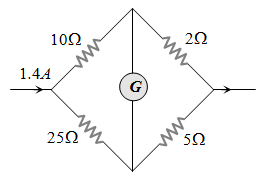
In the circuit shown in the figure, the current flowing in 2 Ω resistance
In a circuit, the value of the alternating current is measured by hot wire ammeter as $10$ ampere. Its peak value will be......$A$
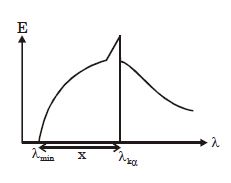
Difference between $\lambda _{k_{\alpha}}$ and $\lambda _{min}$ become twice if accelerating potential changes from $3100\ volt$ to $12400\ volt$ . Find $\lambda _{k_{\alpha} }$ ........$\mathop A\limits^o $ (Given $hc = 12400\ eVÅ$ ) 
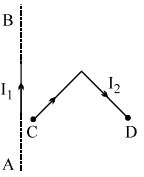
In the figure shown a current $I_1$ is established in the long straight wire $AB$.Another wire $CD$ carrying current $I_2$ is placed in the plane of the paper. The line joining the ends of this wire is perpendicular to the wire $AB$. The force on the wire $CD$ is:
A radioactive sample at any instant has its disintegration rate 5000 disintegration per minute. After 5 minutes, the rate is 1250 disintegrations per minute. Then, the decay constant (per minute) is
A 10 metre wire kept in east-west falling with velocity 5 m/sec perpendicular to the field $0.3 \times 10^{-4} \mathrm{wb} / \mathrm{m}^2$. The induced e.m.f. across the terminal will be
In which of the following transitions will the wavelength be minimum?
If $10\%$ of a radioactive material decays in $5\, days$ then the amount of the original material left after $20\, days$ is approximately .......... $\%$
A metal wire of resistance $3\,\Omega $ is elongated to make a uniform wire of double its previous length. The new wire is now bent and the ends joined to make a circle. If two points on this circle make an angle $60^o$ at the centre, the equivalent resistance between these two points will be