MCQ
Two particles start simultaneously from the same point and move along two straight lines, one with uniform velocity $v$ and other with a uniform acceleration $a.$ If $\alpha$ is the angle between the lines of motion of two particles then the least value of relative velocity will be at time given by
  • A
    $(v/a)\,\, sin \,\,\alpha$
  • $(v/a)\,\, cos \,\,\alpha$
  • C
    $(v/a)\,\, tan \,\,\alpha$
  • D
    $(v/a)\,\,cot \,\,\alpha$

Answer

Correct option: B.
$(v/a)\,\, cos \,\,\alpha$
b
$\nu_{r}$ is subtraction of vectors. Hence,

$\nu_{r}^{2}=x(\operatorname{say})=\nu^{2}+(a t)^{2}-2 v(a t) \cos \alpha$

Now, $\nu_{r}$ will be minimum when $x$ is minimum

Hence $\frac{d x}{d t}=0$ or $2 a^{2} t-2 \nu a \cos \alpha=0$

$\mathrm{t}=\frac{\nu \cos \alpha}{a}$

Need a full question paper?

Generate a complete, print-ready paper with questions like this in minutes — across 16+ boards, with answer keys.

Start Generating Free

Similar questions

$7$ mole of certain monoatomic ideal gas undergoes a temperature increase of $40 K$ at constant pressure. The increase in the internal energy of the gas in this process is$....J$ (Given $R =8.3 JK ^{-1} mol ^{-1}$ )
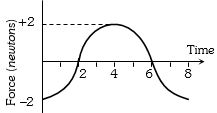
A force-time graph for a linear motion is shown in figure where the segments are circular. The linear momentum gained between zero and $8$ second is
Dot product of two mutual perpendicular vector is
Heat is given to an ideal gas in an isothermal process.

$A.$ Internal energy of the gas will decrease.

$B.$ Internal energy of the gas will increase.

$C.$ Internal energy of the gas will not change.

$D.$ The gas will do positive work.

$E.$ The gas will do negative work.

Choose the correct answer from the options given below :

A projectile is thrown with velocity $U=20\ m/s ± 5\%$ at an angle $60^o.$ If the projectile falls back on the ground at the same level then    ......... $m$ of following can not be a possible answer for range.
If two waves represented by $y_1 = 4\, \sin\, \omega t$  and ${y_2} = 3\sin \,\left( {\omega t + \frac{\pi }{3}} \right)$ interfere at a point, then amplitude of the resulting wave will be about
A particle is observed from two frames S1 and. S2. The frame Smoves with respect to Swith an acceleration a. Let F1 and F2 be the pseudo forces on the particle when seen from S1 and S2 respectively. Which of the following are not possible?
  1. F1 = 0, F2 ≠ 0
  2. F1 ≠ 0, F2 = 0
  3. F1 ≠ 0, F2 ≠ 0
  4. F= 0, F= 0
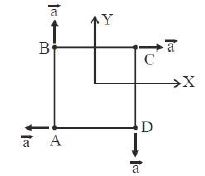
Four particles $A, B, C$ and $D$ with masses $m_A=m, m_B=2m, m_C=3m$ and $m_D=4m$ are at the corners of a square. They have accelerations of equal magnitude with directions as shown. The acceleration of the centre of mass of the particles is
Mass is distributed uniformly over a thin square plate. If two end points of diagonal are $(-2, 0)$ and $(2, 2)$, what are the coordinates of centre of mass of plate ?
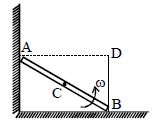
$A$ thin rod $AB$ is sliding between two fixed right angled surfaces. At some instant its angular velocity is $ \omega $. If $I_x$ represent moment of inertia of the rod about an axis perpendicular to the plane and passing through the point $X$ ($A, B, C$ or $D$), the kinetic energy of the rod is