MCQ
Two pendulums have time periods $T$ and $5T/4.$ They start $SHM$ at the same time from the mean position. After how many oscillations of the smaller pendulum they will be again in the same phase :
  • $5$
  • B
    $4$
  • C
    $11$
  • D
    $9$

Answer

Correct option: A.
$5$
a
When the pendulum $A$ with time period $\frac{5 T}{4}$ completes phase of $2 \pi$ in $\frac{5 T}{4},$ the other pendulum $B$ leads by phase $\frac{\pi}{2}$.

So after $4$ oscillations of pendulum $A$ i.e. after $5 T$, pendulum $B$ leads by $2 \pi$ i.e they come in phase.

i.e. after $5$ oscillations of small pendulum (Time taken $=5 T$ ), they will again come in the same phase.

Need a full question paper?

Generate a complete, print-ready paper with questions like this in minutes — across 16+ boards, with answer keys.
Start Generating Free

Similar questions

A particle covers half of its total distance with speed $v_1$ and the rest half distance with speed $v_2 .$ Its average speed during the complete journey is 
$n$ drops of $a$ liquid, each with surface energy $E$, joining to form a single drop
A monoatomic ideal gas, initially at temperature ${T_1},$ is enclosed in a cylinder fitted with a frictionless piston. The gas is allowed to expand adiabatically to a temperature. ${T_2}$ by releasing the piston suddenly. If ${L_1}$ and ${L_2}$ are the lengths of the gas column before and after expansion respectively, then ${T_1}/{T_2}$ is given by
Two bodies having same mass $40\, kg$ are moving in opposite directions, one with a velocity of $10$$m/s$ and the other with $7\,m/s.$ If they collide and move as one body, the velocity of the combination is ........ $m/s$
A boy of $50 \,kg$ is in a lift moving down with an acceleration $9.8\,m{s^{ - 2}}$. The apparent weight of the body is........... $N$ $(g = 9.8\,m{s^{ - 2}})$
To get the maximum flight, a ball must be thrown as
The specific heats, $C_P$ and $C_V$ of a gas of diatomic molecules, $A$, are given (in units of $J\, mol^{-1}\, K^{-1}$) by $29$ and $22$, respectively. Another gas of diatomic molecules $B$, has the corresponding values $30$ and $21$. If they are treated as ideal gases, then
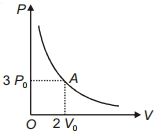
The variation of pressure $P$ with volume $V$ for an ideal monatomic gas during an adiabatic process is shown in figure. At point $A$ the magnitude of rate of change of pressure with volume is
A barometer kept in an elevator accelerating upward reads 76cm. The air pressure in the elevator is
One solid sphere $A$ and another hollow sphere $B$ are of same mass and same outer radius. Their moments of inertia about their diameters are respectively, $I_A$ and $I_B$ such that: