Two perfectly identical wires are in unison. When the tension in one wire is increased by $1\%$, then on sounding them together $3$ beats are heard in $2 \,sec$. The initial frequency of each wire is .... ${\sec ^{ - 1}}$
Easy


Download our appand get started for free
Experience the future of education. Simply download our apps or reach out to us for more information. Let's shape the future of learning together!No signup needed.*
Similar Questions
- 1While measuring the speed of sound by performing a resonance column experiment, a student gets the first resonance condition at a column length of $18\,cm$ during winter. Repeating the same experiment during summer, she measures the column length to be $x\,cm$ for the second resonance. ThenView Solution
- 2Two sound waves of slightly different frequencies have amplitude ratio $\frac{11}{9} .$ What is the difference of sound levels in decibels of maximum and minimum intensities heard at a point :- ............. $\mathrm{dB}$View Solution
- 3A tuning fork of frequency $392 Hz,$ resonates with $50 cm $ length of a string under tension ($T$). If length of the string is decreased by $2\%$, keeping the tension constant, the number of beats heard when the string and the tuning fork made to vibrate simultaneously isView Solution
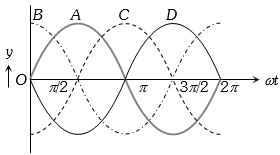
- 4The figure shows four progressive waves $A, B, C$ and $D $ with their phases expressed with respect to the wave $A$. It can be concluded from the figure thatView Solution
- 5View SolutionThe following phenomenon cannot be observed for sound waves
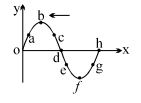
- 6The figure represents the instantaneous picture of a transverse harmonic wave traveling along the negative $x$-axis. Choose the correct alternative $(s)$ related to the movement of the nine points shown in the figure. The points moving upward is/areView Solution
- 7A man stands in front of a hillock and fires a gun. He hears an echo after $1.5\, sec$. The distance of the hillock from the man is ...... $m$ (velocity of sound in air is $330\, m/s$)View Solution
- 8The equation of the progressive wave, where $t$ is the time in second, $x$ is the distance in metre is $y=A \cos 240\left(t-\frac{x}{12}\right)$. The phase difference (in $SI$ units) between two positions $0.5 \,m$ apart is ...........View Solution
- 9A student is performing an experiment using a resonance column and a tuning fork of frequency $244 s ^{-1}$. He is told that the air in the tube has been replaced by another gas (assume that the column remains filled with the gas). If the minimum height at which resonance occurs is $(0.350 \pm 0.005) m$, the gas in the tube isView Solution
(Useful information) : $\sqrt{167 R T}=640 j^{1 / 2} mole ^{-1 / 2} ; \sqrt{140 RT }=590 j ^{1 / 2} mole ^{-1 / 2}$. The molar masses $M$ in grams are given in the options. Take the value of $\sqrt{\frac{10}{ M }}$ for each gas as given there.)
- 10An observer starts moving with uniform acceleration $a$ toward a stationary sound source emitting a whistle of frequency $n.$ As the observer approaches source, the apparent frequency, heard by the observer varies with time asView Solution