MCQ
Two plane mirrors at an angle such that a ray incident on a mirror undergoes a total deviation of $240^o$ after two reflections.
  • A
    the angle between the mirror is $60^o$
  • B
    the number of images formed by this system will be $5$, if an object is placed symmetrically between the mirrors.
  • C
    the no. of images will be $5$ if an object is kept unsymmetrically between the mirrors.
  • All of the above

Answer

Correct option: D.
All of the above
d

Need a full question paper?

Generate a complete, print-ready paper with questions like this in minutes — across 16+ boards, with answer keys.

Start Generating Free

Similar questions

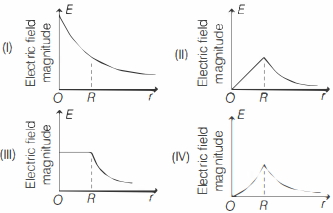
An isolated sphere of radius $R$ contains uniform volume distribution of positive charge. Which of the curve shown below, correctly illustrates the dependence of the magnitude of the electric field of the sphere as a function of the distance $r$ from its centre?
Magnetic field due to a ring having n turns at a distance x on its axis is proportional to (if r = radius of ring)
Consider two point charges of equal magnitude and opposite sign separated by a certain distance. The neutral point due to them
A beam of light of wavelength $\lambda $ and with illumination $L$ falls on a clean surface of sodium. If $N$ photoelectrons are emitted each with kinetic energy $E$, then
The pointer of a dead-beat galvanometer gives a steady deflection because
In a Young's experiment, two coherent sources are placed 0.90 mm apart and the fringes are observed one metre away. If it produces the second dark fringe at a distance of 1 mm from the central fringe, the wavelength of monochromatic light used would be
What will be the angular momentum of a electron, if energy of this electron in $H-$atom is $1.5\,eV$ (in $J-sec$)
If a unit positive charge is taken from one point to another over an equipotential surface, then:
The Lyman transitions involve:
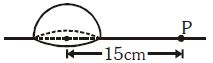
Figure shows a solid hemisphere with a charge of $5\ nC$ distributed uniformly through its volume. The hemisphere lies on a plane and point $P$ is located on this plane, along a radial line from the centre of curvature at distance $15\ cm$. The electric potential at point $P$ due to the hemisphere, is .....$V$