MCQ
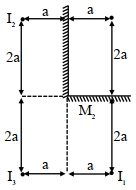
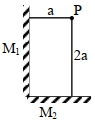
Two plane mirrors ${M}_{1}$ and ${M}_{2}$ are at right angle to each other shown. A point source $'P'$ is placed at $'a'$ and $'2a'$ meter away from ${M}_{1}$ and ${M}_{2}$ respectively. The longest distance between the images thus formed is : (Take $\sqrt{5}=2.3$ )
  • A
    $3 {a}$
  • $4.6 {a}$
  • C
    $2.3 {a}$
  • D
    $2 \sqrt{10} {a}$

Answer

Correct option: B.
$4.6 {a}$
b
Shortest distance is $2 {a}$ between ${I}_{1} \& {I}_{3}$

But answer given is for ${I}_{1} \& {I}_{2}$

$\sqrt{(4 a)^{2}+(2 a)^{2}}$

$a \sqrt{20}$

$4.47 {a}$

Need a full question paper?

Generate a complete, print-ready paper with questions like this in minutes — across 16+ boards, with answer keys.

Start Generating Free

Similar questions

A sample contains mixture of helium and oxygen gas. The ratio of root mean square speed of helium and oxygen in the sample, is $:$
A particle moves along a circle with a constant angular speed $\omega$ Its displacement,with respect to this position of the particle at time $t = 0$ is plotted against time. The graph would look like
Stationary waves are produced in $10\,m$  long stretched string. If the string Vibrates in $5$ segments and wave velocity  $20\,m/s$ the frequency is ..... $Hz$
To maintain a rotor at a uniform angular speed of $100\, rad\, s^{-1}$, an engine needs to transmit torque of $100\, Nm$. The power of the engine is
Logic gates are constructed by
A capacitor of $2\,\, \mu F$ is charged as shown in the diagram. When the switch $S$ is turned to position $2,$ the percentage of its stored energy dissipated is ......$\%$ 
Hooke's law is applicable for ....
The value of $\gamma\left(=\frac{\mathrm{C}_{\mathrm{p}}}{\mathrm{C}_{\mathrm{v}}}\right),$ for hydrogen, hellium and another ideal diatomic gas $X$(whose molecules are not rigid but have an additional vibrational mode), are respectively equal to 
$A$ reversible engine converts one-sixth of the heat input into work. When the temperature of the sink is reduced by $ 62^oC$, the efficiency of the engine is doubled. The temperatures of the source and sink are
A monochromatic point source of light is placed at a distance $d$ from a metal surface. Photo electrons are ejected at a rate $n$ per second, and with maximum kinetic energy $E$. If the source is brought nearer to distance $d / 2$, the rate and the maximum kinetic energy per photoelectron become nearly