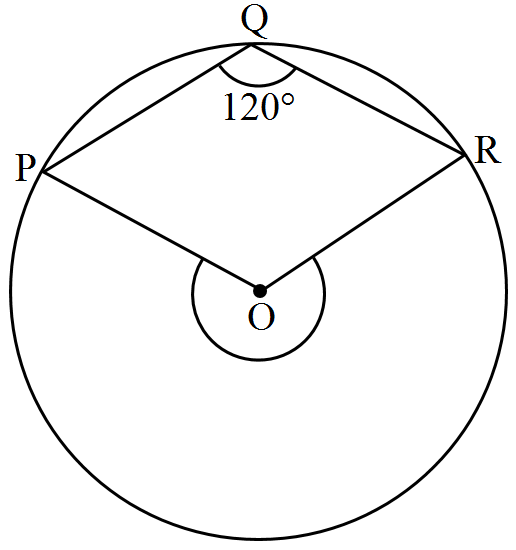
MCQ
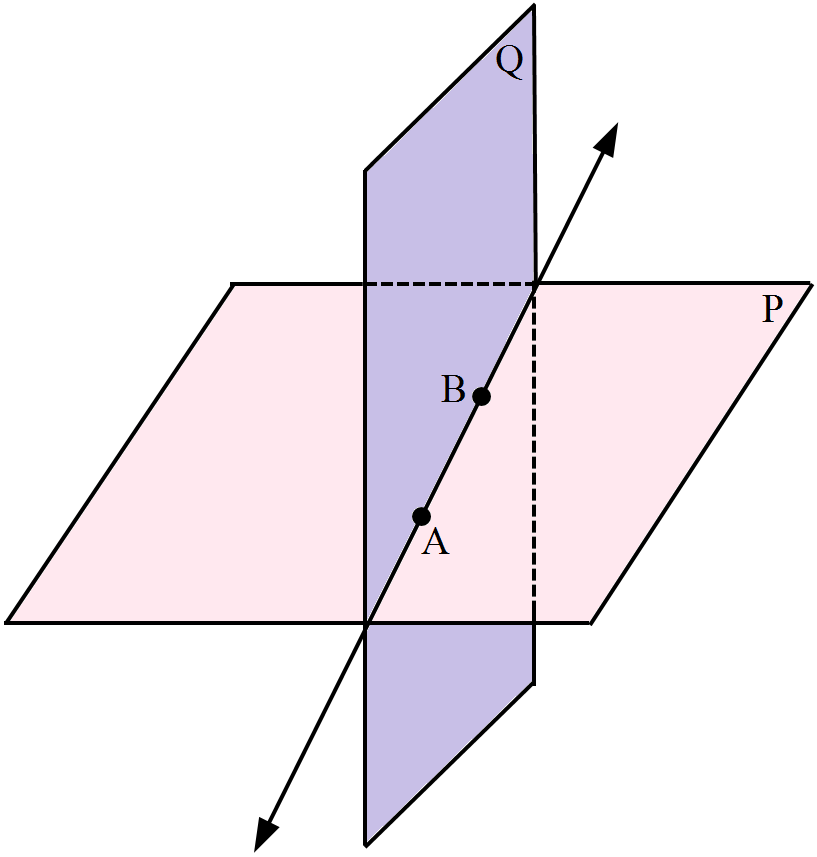
Two planes intersect each other to form a:
  • A
    Plane.
  • B
    Point.
  • C
    Angle.
  • D
    Straight line.

Need a full question paper?

Generate a complete, print-ready paper with questions like this in minutes — across 16+ boards, with answer keys.
Start Generating Free

Similar questions

Euclid's which axiom illustrates the statement that when x + y = 15 then x + y + 2 = 15 + z?
  1. Frist.
  2. Second.
  3. Third.
  4. Fourth.
In Fig , $P Q R S$ is a parallelogram. Can it be concluded that $\triangle R P S \cong \triangle Q S P$ ? Why or why not?
Directions: In the following questions, the Assertions (A) and Reason(s) (R) have been put forward. Read both the statements carefully and choose the correct alternative from the following:
Assertion: The perimeter of a right angled triangle is 60cm and its hypotenuse is 26cm. The other sides of the triangle are 10cm and 24cm. Also, area of the triangle is 120cm2.
Reason: (Base)2 + (Perpendicular)2 = (Hypotenuse)2.
If $\frac{3^{2\text{x}-8}}{225}=\frac{5^3}{5^{\text{x}}},$ then x =
Choose the rational number which does not lie between $-\frac{2}{3}$ and $-\frac{1}{5}.$
  1. $-\frac{3}{10}$
  2. $\frac{3}{10}$
  3. $-\frac{1}{4}$
  4. $-\frac{7}{20}$
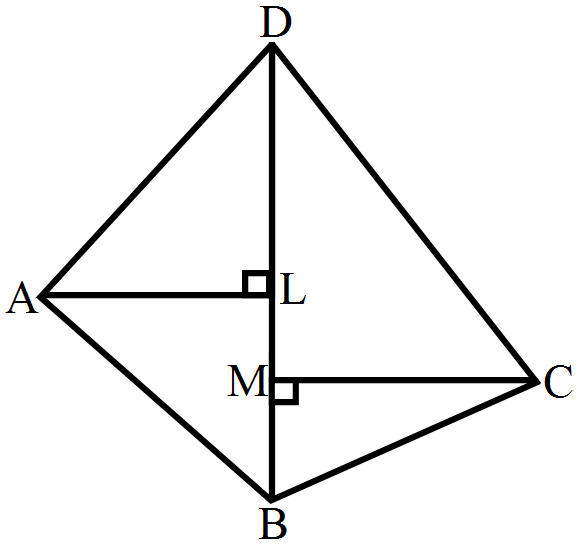
In a quadrilateral ABCD, it is given that BD = 16cm. If $\text{AL}\perp\text{BD}$ and $\text{CM}\perp\text{BD}$ such that AL = 9cm and CM = 7cm, then ar(quadrilateral ABCD) = ?

  1. 256cm2
  2. 128cm2
  3. 64cm2
  4. 96cm2

The lateral surface area of a cylinder is:
  1. $\pi\text{r}^2\text{h}$
  2. $\pi\text{rh}$
  3. $2\pi\text{rh}$
  4. $2\pi\text{r}^2$
A rational number lying between $\sqrt{2}$ and $\sqrt{3}$ is:
  1. $\frac{\big(\sqrt{2}+\sqrt{3}\big)}{2}$
  2. $\sqrt{6}$
  3. 1.6
  4. 1.9
It is given that$\triangle\text{ABC}\cong\triangle\text{FDE}$ in which AB = 5cm, $\angle\text{B}=40^{\circ},\angle\text{A}=80^{\circ}$and FD = 5cm. Then, which of the following is true?
  1. $\angle\text{D}=60^{\circ}$
  2. $\angle\text{E}=60^{\circ}$
  3. $\angle\text{F}=60^{\circ}$
  4. $\angle\text{D}=80^{\circ}$