MCQ
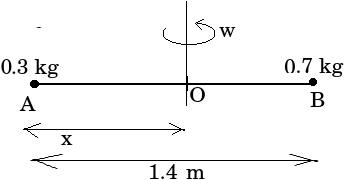
Two point masses of $0.3\ kg$ and $0.7\ kg$ are fixed at the ends of a rod of length $1.4\ m$  and of negligible mass. The rod is set rotating about an axis perpendicular  to its length with a uniform angular speed. The point on the rod through which the axis should pass in order that the work required for rotation of the rod is minimum is located at a distance of  
  • A
    $0.4\ m$  from mass of $ 0.3\ kg$
  • $0.98\ m$  from mass of $0.3\ kg$
  • C
    $0.70\ m$  from mass of $0.7\ kg$
  • D
    $0.98\ m$  from mass of $0.7\ kg$

Answer

Correct option: B.
$0.98\ m$  from mass of $0.3\ kg$
b
$Work-energy$ theorem, $\quad W_{\text {all forces }}=\frac{1}{2} I w^{2}$

Given$:$ $w$ is constant

So required work done to be minimum implies that $I$ must be minimum.

Let the rotational axis passes through O. $I=0.3\left(x^{2}\right)+0.7(1.4-x)^{2}$

For $I$ to be minimum, $\quad \frac{d I}{d x}=0$

$\Longrightarrow 0.3 \times 2(x)-0.7 \times 2(1.4-x)=0$

$\Longrightarrow x=0.98 m$

Need a full question paper?

Generate a complete, print-ready paper with questions like this in minutes — across 16+ boards, with answer keys.

Start Generating Free

Similar questions

Two liquids $A$ and $B$ are at $32°C$ and $24°C$. When mixed in equal masses the temperature of the mixture is found to be $28°C$. Their specific heats are in the ratio of
Two identical solid spheres each of mass $2\,kg$ and radii $10\,cm$ are fixed at the ends of a light rod. The separation between the centres of the spheres is $40\,cm$. The moment of inertia of the system about an axis perpendicular to the rod passing through its middle point is $........... \times 10^{-3}\,kg - m ^2$
Change in temperature of the medium changes:
Given below are two statements :

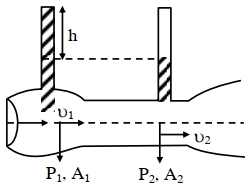
Statement $I$ : When speed of liquid is zero everywhere, pressure difference at any two points depends on equation $\mathrm{P}_1-\mathrm{P}_2=\rho \mathrm{g}\left(\mathrm{h}_2-\mathrm{h}_1\right)$

Statement $II$ : In ventury tube shown $2 \mathrm{gh}=v_1^2-v_2^2$

In the light of the above statements, choose the most appropriate answer from the options given below.

If there is change of angular momentum from $1\,J$ to $5\, J$ in $5\, second$. Then the torque is :
$300\, gm$ of water at $25°C$ is added to $100\, gm$ of ice at $0°C$. The final temperature of the mixture is........ $^oC$
A proton is kept at rest. A positively charged particle is released from rest at a distance $d$ in its field. Consider two experiments one in which the charged particle is also a proton and in another, a positron. In the same time $t,$ the work done on the two moving charged particles is:
When the speed of a body is doubled, its kinetic energy becomes:
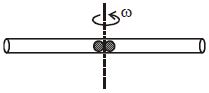
A smooth tube of certain mass closed at both ends is rotated in a gravity free space and released. The two balls shown in figure moves towards the ends of the tube and stay there. Then which statement is incorrect about this whole system
A particle of unit mass is moving along the $x$-axis under the influence of a force and its total energy is conserved. Four possible forms of the potential energy of the particle are given in column $I$ (a and $U _0$ are constants). Match the potential energies in column $I$ to the corresponding statement$(s)$ in column $II.$

column $I$ column $II$
$(A)$ $U _1( x )=\frac{ U _0}{2}\left[1-\left(\frac{ x }{ a }\right)^2\right]^2$ $(P)$ The force acting on the particle is zero at $x = a$.
$(B)$ $U _2( x )=\frac{ U _0}{2}\left(\frac{ x }{ a }\right)^2$ $(Q)$ The force acting on the particle is zero at $x=0$.
$(C)$ $U _3( x )=\frac{ U _0}{2}\left(\frac{ x }{ a }\right)^2 \exp \left[-\left(\frac{ x }{ a }\right)^2\right]$ $(R)$ The force acting on the particle is zero at $x =- a$.
$(D)$ $U _4( x )=\frac{ U _0}{2}\left[\frac{ x }{ a }-\frac{1}{3}\left(\frac{ x }{ a }\right)^3\right]$ $(S)$ The particle experiences an attractive force towards $x =0$ in the region $| x |< a$.
  $(T)$ The particle with total energy $\frac{ U _0}{4}$ can oscillate about the point $x=-a$.