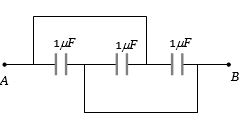
Three capacitors of capacitance $3\,\mu \,F$ are connected in a circuit. Then their maximum and minimum capacitances will be
Easy
Download our app for free and get started
(a) ${C_{\max }} = nC = 3 \times 3 = 9\,\mu F$, ${C_{\min }} = \frac{C}{n} = \frac{3}{3} = 1\,\mu F$

Download our appand get started for free
Experience the future of education. Simply download our apps or reach out to us for more information. Let's shape the future of learning together!No signup needed.*
Similar Questions
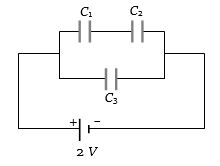
- 1Two capacitors ${C_1} = 2\,\mu \,F$ and ${C_2}\, = \,6\,\mu \,F$ in series, are connected in parallel to a third capacitor ${C_3} = \,4\,\mu \,F$. This arrangement is then connected to a battery of $e.m.f.$ $=$ $2V$, as shown in the figure. How much energy is lost by the battery in charging the capacitorsView Solution
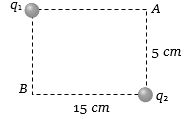
- 2$n$ the rectangle, shown below, the two corners have charges ${q_1} = - 5\,\mu C$ and ${q_2} = + 2.0\,\mu C$. The work done in moving a charge $ + 3.0\,\mu C$ from $B$ to $A$ is.........$J$ $(1/4\pi {\varepsilon _0} = {10^{10}}\,N{\rm{ - }}{m^2}/{C^2})$View Solution
- 3An electric dipole with dipole moment $\vec p = (3i + 4j) \times 10^{-30} C-m$ is placed in an electric field $\vec E = 4000 \hat i (N/C).$ An external agent turns the dipole slowly until its electric dipole moment becomes $(-4 \hat i + 3 \hat j) ×10^{-30}C-m.$ The work done by the external agent is equal to :-View Solution
- 4View SolutionA capacitor is charged by using a battery which is then disconnected. A dielectric slab is introduced between the plates which results in
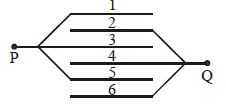
- 5Six metallic plates each with a surface area of one side $A$, are placed at a distance $d$ from each other. The alternate plates are connected to points $P$ and $Q$ as shown in figure. The capacitance of the system isView Solution
- 6A parallel plate capacitor has a uniform electric field $E$ in the space between the plates. If the distance between the plates is $d$ and area of each plate is $A,$ the energy stored in the capacitor isView Solution
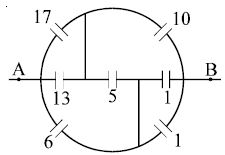
- 7Find equivalent capacitance across $AB$.....$ \mu F$ (all capacitances in $\mu F$)View Solution
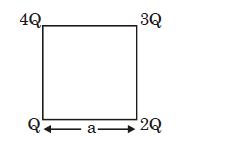
- 8View SolutionElectrostatic potential energy of given system will be
- 9Two metal spheres $A$ and $B$ of radii $a$ and $b(a < b)$ respectively are at a large distance apart. Each sphere carries a charge of $100 \mu C$. The spheres are connected by a conducting wire, thenView Solution
- 10The equivalent capacitance in the circuit between $A$ and $B$ will be.....$\mu \,F$View Solution