MCQ
Two projectiles $A$ and $B$ are thrown with the same speed such that $A$ makes angle $\theta$ with the horizontal and $B$ makes angle $\theta$ with the vertical, then
  • A
    Both must have same time of flight
  • B
    Both must achieve same maximum height
  • C
    Amust have more horizontal range than $B$
  • Both may have same time of flight

Answer

Correct option: D.
Both may have same time of flight
d
Depending on the value of $\theta$ one can have same or different time of flight, range o maximum height. Therefore must statement is wrong. They may be equal or may not be. This is only possible for $\theta=45^{\circ}$

Need a full question paper?

Generate a complete, print-ready paper with questions like this in minutes — across 16+ boards, with answer keys.

Start Generating Free

Similar questions

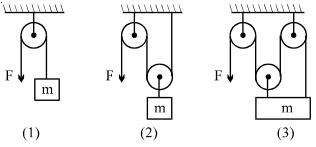
Equal force $F ( > mg)$ is applied to string in all the $3$ cases. Starting from rest, the point of application of force moves a distance of $2 m$ down in all cases. In which case the block has maximum kinetic energy?
A solid sphere, a hollow sphere and a disc, all having same mass and radius, are placed at the top of an incline and released. The friction coefficients between the objects and the incline are same and not sufficient to allow pure rolling. Least time will be taken in reaching the bottom by:
A man is sitting in a boat which is floating in a pond. If the man drinks same water from the pond, the level of water in pond will
The frequency of a tunning fork is $384$ per second and velocity of sound in air is $352 m/s$. How far the sound has traversed while fork completes $36$ vibration .... $m$
$List I$ describes thermodynamic processes in four different systems. $List II$ gives the magnitudes (either exactly or as a close approximation) of possible changes in the internal energy of the system due to the process.

$List-I$ $List-II$
($I$) $10^{-3} kg$ of water at $100^{\circ} C$ is converted to steam at the same temperature, at a pressure of $10^5 Pa$. The volume of the system changes from $10^{-6} m ^3$ to $10^{-3} m ^3$ in the process. Latent heat of water $=2250 kJ / kg$. ($P$) $2 kJ$
($II$) $0.2$ moles of a rigid diatomic ideal gas with volume $V$ at temperature $500 K$ undergoes an isobaric expansion to volume $3 V$. Assume $R=8.0 Jmol ^1 K^{-1}$. ($Q$) $7 kJ$
($III$) On mole of a monatomic ideal gas is compressed adiabatically from volume $V=\frac{1}{3} m^3$ and pressure $2 kPa$ to volume $\frac{v}{8}$ ($R$) $4 kJ$
($IV$) Three moles of a diatomic ideal gas whose molecules can vibrate, is given $9 kJ$ of heat and undergoes isobaric expansion. ($S$) $5 kJ$
  ($T$) $3 kJ$

Which one of the following options is correct?

Suppose a player hits several baseballs. Which baseball will be in the air for the longest time?
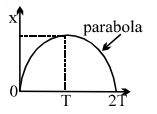
The $x-t$ graph of a particle moving along a straight line is shown in figure The speed-time graph of the particle is correctly shown by
A big drop is formed by coalescing $1000$ small droplets of water. The surface energy will become :
A sphere is rotating about a diameter
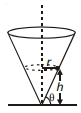
A particle describes a horizontal circle of radius $r$ on the smooth surface of an inverted cone as shown. The height of plane of circle above vertex is $h$. The speed of particle should be