MCQ
Two radioactive materials $X_1$ and $X_2$ have decay constant $5\lambda$ and $\lambda$ respectively intially they have the saame number of nuclei, then the ratio of the number of nuclei of $X_1$ to that $X_2$ will be $\frac{1}{e}$ after a time
  • A
    $4λ$
  • B
    $2λ$
  • C
    $\frac{1}{{2\lambda }}$
  • $\;\frac{1}{{4\lambda }}$

Answer

Correct option: D.
$\;\frac{1}{{4\lambda }}$
d
$X_{1}=N_{0} e^{-\lambda_{1} t}$ ;  $X_{2}=N_{0} e^{-\lambda_{2} t}$

$\frac{X_{1}}{X_{2}}=e^{-1}$ $=e^{\left(-\lambda_{1}+\lambda_{2}\right) t}$ ; ${e^{ - 1}} = {e^{ - (\lambda 1 - \lambda 2)t}}$

$\therefore t=\left|\frac{1}{\lambda_{1}-\lambda_{2}}\right|=\frac{1}{(5 \lambda-\lambda)}=\frac{1}{4 \lambda}$

Need a full question paper?

Generate a complete, print-ready paper with questions like this in minutes — across 16+ boards, with answer keys.

Start Generating Free

Similar questions

A sphere encloses an electric dipole with charge $\pm 3 \times 10^{-6} \;\mathrm{C} .$ What is the total electric flux across the sphere?......${Nm}^{2} / {C}$
A block of mass $m$ moving with speed $v$ compresses a spring through distance $x$ before its speed is halved. What is the value of spring constant ?
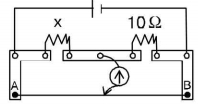
A meter bridge is set up as shown, to determine an unknown resistance ' $X$ ' using a standard $10\,ohm$ resistor. The galvanometer shows null point when tapping-key is at $52\,cm$ mark. The endcorrections are $1\,cm$ and $2\,cm$ respectively for the ends $A$ and $B$. The determined value of ' $X$ ' is $..........\Omega$
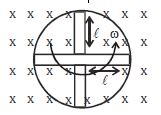
A conducting wheel in which there are four rods of lengthe $l$ as shown in figure is rotating with angular velocity $\omega $ in a uniform magnetic field $B$. The induced potential difference between its centre and rim will be
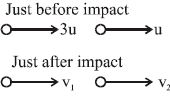
Two smooth objects with a coefficient of restitution $e,$ collide directly and bounce as shown. Newton's law of restitution gives
Monochromatic light is refracted from air into the glass of refractive index $\mu $. The ratio of the wavelength of incident and refracted waves is
On moving a charge of $20$ coulombs by $2 \;cm , 2 \;J$ of work is done, then the potential difference between the points is (in $volt$)
A boy of mass $20 \ kg$ is standing on a $80 \ kg$ free to move long cart. There is negligible friction between cart and ground. Initially, the boy is standing $25 m$ from a wall. If he walks $10 m$ on the cart towards the wall, then the final distance of the boy from the wall will be $........ m$
Consider four conducting materials copper, tungsten, mercury and aluminium with resistivity $\rho_{ C }, \rho_{ T }, \rho_{ M }$ and $\rho_{ A }$ espectively Then:
If $10^{22}$ gas molecules each of mass $10^{-26}\, kg$ collide with a surface (perpendicular to it)elastically per second over an area $1\, m^2$ with a speed $10^4\,m/s$, the pressure exerted by the gas molecules will be of the order of