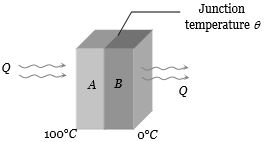
Two rectangular blocks $A$ and $B$ of different metals have same length and same area of cross-section. They are kept in such a way that their cross-sectional area touch each other. The temperature at one end of $A$ is $100°C$ and that of $B$ at the other end is $0°C$ . If the ratio of their thermal conductivity is $1 : 3$ , then under steady state, the temperature of the junction in contact will be ........ $^oC$
Medium
Download our app for free and get started
(a) It is given that $\frac{{{K_1}}}{{{K_2}}} = \frac{1}{3}$ ==> ${K_1} = K$ then ${K_2} = 3K$
the temperature of the junction in contact
$\theta = \frac{{{K_1}{\theta _1} + {K_2}{\theta _2}}}{{{K_1} + {K_2}}}$$ = \frac{{1 \times 100 + 3 \times 0}}{{1 + 3}} = \frac{{100}}{4}$= $25°C$
Download our app
and get started for free
Experience the future of education. Simply download our apps or reach out to us for more information. Let's shape the future of learning together!No signup needed.*
A copper rod and a steel rod of equal cross-sections and lengths $(L)$ are joined side by side and connected between two heat baths as shown in the figure
If heat flows through them from $x = 0$ to $x = 2L$ at a steady rate and conductivities of the metals are $K_{cu}$ and $K_{steel}$ $(K_{cu} > K_{steel}),$ then the temperature varies as (convection and radiation are negligible)
Water and turpentine oil (specific heat less than that of water) are both heated to same temperature. Equal amounts of these placed in identical calorimeters are then left in air
The heat is flowing through a rod of length $50 cm$ and area of cross-section $5c{m^2}$. Its ends are respectively at ${25^o}C$ and ${125^o}C$. The coefficient of thermal conductivity of the material of the rod is $0.092 kcal/m×s×^\circ C$. The temperature gradient in the rod is
Distance between sun and Earth is $2 \times 10^{8}\, km ,$ temperature of sun $6000\, K ,$ radius of sun $7 \times 10^{5}\, km .$ If emmisivity of the earth is $0.6,$ find out the temperature of the earth in thermal equilibrium (in $k$)
Two identical objects $A$ and $B$ are at temperatures $T_A$ and $T_B$ respectively. Both objects are placed in a room with perfectly absorbing walls maintained at temperatures T $({T_A} > T > {T_B}).$ The objects A and B attain temperature $T $ eventually which one of the following is correct statement
Three rods of Copper, Brass and Steel are welded together to form a $Y$ shaped structure. Area of cross - section of each rod $= 4\ cm^2$ . End of copper rod is maintained at $100^o C $ where as ends ofbrass and steel are kept at $0^o C$. Lengths of the copper, brass and steel rods are $46, 13$ and $12\ cms$ respectively. The rods are thermally insulated from surroundings excepts at ends. Thermal conductivities of copper, brass and steel are $0.92, 0.26$ and $0.12\ CGS$ units respectively. Rate ofheat flow through copper rod is ....... $cal\, s^{-1}$
A composite rod made of three rods of equal length and cross-section as shown in the fig. The thermal conductivities of the materials of the rods are $K/2, 5K$ and $K$ respectively. The end $A$ and end $B$ are at constant temperatures. All heat entering the face Agoes out of the end $B$ there being no loss of heat from the sides of the bar. The effective thermal conductivity of the bar is