The figure given below shows the variation in the internal energy $U$ with volume $V$ of $2.0\ mole$ of an ideal gas in a cyclic process $abcda$ . The temperatures of the gas during the processes $ab$ and $cd$ are $500\ K$ and $300\ K$ respectively, the heat absorbed by the gas during the complete process is .... $J$
(Take $R$ = $8.3\ J/mol-K$ and $ln\ 2$ = $0.69$)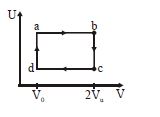
Diffcult
Download our app for free and get started
Given an ideal gas whose $n=2.0$ moles
In the cyclic proces $\Delta \mathrm{U}=0$
Here $\mathrm{Q}=\Delta \mathrm{U}+\mathrm{W} .$ As $\Delta \mathrm{U}=0$
the amount of heat absorbed.
$\mathrm{Q}=\mathrm{W}=\mathrm{W}_{\mathrm{ab}}+\mathrm{W}_{\mathrm{cd}}$
$=\mu \mathrm{RT}_{1} \ell n \left(\frac{2 \mathrm{V}_{0}}{\mathrm{V}_{0}}\right)+\mu \mathrm{RT}_{2} \ln \left(\frac{\mathrm{V}_{0}}{2 \mathrm{V}_{0}}\right)$
$=2 \times 8.3 \times 0.69(500-300)=2291 \mathrm{J}$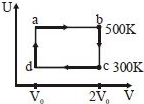

Download our appand get started for free
Experience the future of education. Simply download our apps or reach out to us for more information. Let's shape the future of learning together!No signup needed.*
Similar Questions
- 1In a process, temperature and volume of one mole of an ideal monoatomic gas are varied according to the relation $VT = K$, where $I$ is a constant. In this process the temperature of the gas is increased by $\Delta T$. The amount of heat absorbed by gas is ($R$ is gas constant)View Solution
- 2Initial pressure and volume of a gas are $P$ and $V$ respectively. First it is expanded isothermally to volume $4V$ and then compressed adiabatically to volume $V$ . The final pressure of gas will be (given $\gamma = 3/2$ )View Solution
- 3An ideal gas is made to undergo the cyclic process shown in the figure below. Let $\Delta W$ depict the work done, $\Delta U$ be the change in internal energy of the gas and $Q$ be the heat added to the gas. Sign of each of these three quantities for the whole cycle will be (0 refers to no change)View Solution

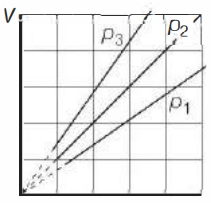
- 4View SolutionThe state of an ideal gas was changed isobarically. The graph depicts three such isobaric lines. Which of the following is true about the pressures of the gas?
- 5The pressure of an ideal gas varies with volume as $P = \alpha V,$ where $\alpha $ is a constant. One mole of the gas is allowed to undergo expansion such that its volume becomes $'m'$ times its initial volume. The work done by the gas in the process isView Solution
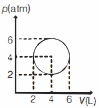
- 6An ideal gas undergoes a circular cycle centred at $4 \,atm , 4 L$ as shown in the diagram. The maximum temperature attained in this process is close toView Solution
- 7View SolutionA measure of the degree of disorder of a system is known as
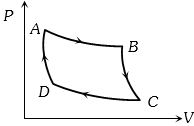
- 8Carnot cycle (reversible) of a gas represented by a Pressure-Volume curve is shown in the diagramConsider the following statementsView Solution
$I.$ Area $ABCD =$ Work done on the gas
$II.$ Area $ABCD =$ Net heat absorbed
$III.$ Change in the internal energy in cycle $= 0$
Which of these are correct
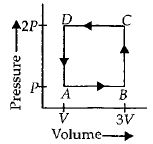
- 9A thermodynamic system is taken through the cycle $ABCD$ as shown in figure. Heat rejected by the gas during the cycle isView Solution
- 10A system is given $300$ calories of heat and it does $600$ joules of work. How much does the internal energy of the system change in this process ..... $J$. ($J = 4.18$ joules/cal)View Solution