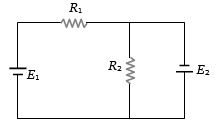
Two resistances ${R_1}$ and ${R_2}$ are joined as shown in the figure to two batteries of $e.m.f.$ ${E_1}$ and ${E_2}$. If ${E_2}$ is short-circuited, the current through ${R_1}$ is
Medium
Download our app for free and get started
(a) After short circuiting, $R_2$ becomes meaningless.

Download our appand get started for free
Experience the future of education. Simply download our apps or reach out to us for more information. Let's shape the future of learning together!No signup needed.*
Similar Questions
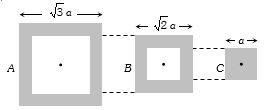
- 1Following figure shows cross-sections through three long conductors of the same length and material, with square cross-section of edge lengths as shown. Conductor $B$ will fit snugly within conductor $A$, and conductor $C$ will fit snugly within conductor $B$. Relationship between their end to end resistance isView Solution
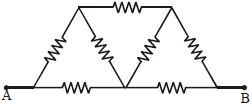
- 2In the network shown in the following figure, each resistance is $1\,ohm.$ The effective resistance between $A$ and $B$ isView Solution
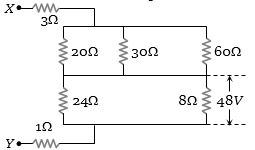
- 3The potential difference across $8\, ohm$ resistance is $48\, volt$ as shown in the figure. The value of potential difference across $X$ and $Y$ points will be ............. $volt$View Solution
- 4Assume a hypothetical wire in which free electron density changes with temperature in proportionality $n\ \alpha \ T$ assuming $\tau $(Relaxation time of collision) and dimensions of wire remain unchanged with increasing temperature. Which one of the resistance $v/s$ temperature graph is trueView Solution
- 5One end of a Nichrome wire of length $2\,L$ and cross-sectional area $A$ is attatched to an end of another Nichrome wire of length $L$ and cross-sectional area $2\,A$. If the free end of the longer wire is at an electric potential of $8.0$ $\mathrm{volts}$, and the free end of the shorter wire is at an electric potential of $1.0$ $\mathrm{volt}$, the potential at the junction of the two wires is equal to ............. $V$View Solution
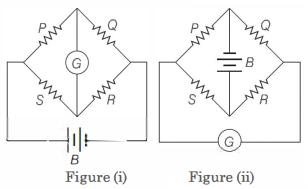
- 6Figure $(i)$ below shows a Wheatstone's bridge in which $P, Q, R$ and $S$ are fixed resistances, $G$ is a galvanometer and $B$ is a battery. For this particular case, the galvanometer shows zero deflection. Now, only the positions of $B$ and $G$ are interchanged, as shown in figure $(ii)$. The new deflection of the galvanometerView Solution
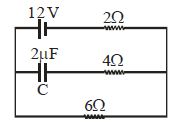
- 7Find the maximum charge on the capacitor $C$ in the following circuit ............ $\mu C$View Solution
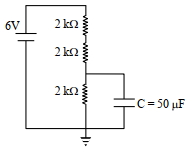
- 8A capacitor of $50 \,\mu {F}$ is connected in a circuit as shown in figure. The charge on the upper plate of the capacitor is $......\,\mu {C} .$View Solution
- 9Two rods of same material and length have their electric resistance in ratio $1:2$. When both rods are dipped in water, the correct statement will beView Solution
- 10Two non-ideal identical batteries are connected in parallel. Consider the following statementsView Solution
$(i)$ The equivalent e.m.f. is smaller than either of the two $e.m.f.$ is
$(ii)$ The equivalent internal resistance is smaller than either of the two internal resistances