Two resistors are connected $(a)$ in series $(b)$ in parallel. The equivalent resistance in the two cases are $9$ $ohm$ and $2$ $ohm$ respectively. Then the resistances of the component resistors are
Medium
Download our app for free and get started
(b) ${R_1} + {R_2} = 9$ and $\frac{{{R_1}{R_2}}}{{{R_1} + {R_2}}} = 2$ $ \Rightarrow $ ${R_1}{R_2} = 18$
${R_1} - {R_2} = \sqrt {{{({R_1} + {R_2})}^2} - 4{R_1}{R_2}} = \sqrt {81 - 72} = 3$
${R_1} = 6\,\Omega ,\,{R_2} = 3\,\Omega $

Download our appand get started for free
Experience the future of education. Simply download our apps or reach out to us for more information. Let's shape the future of learning together!No signup needed.*
Similar Questions
- 1The temperature coefficient of resistance for a wire is $0.00125\,^oC$. At $300\,K$ its resistance is $1\, ohm$. The temperature at which the resistance becomes $2\, ohm$ is .......... $K$View Solution
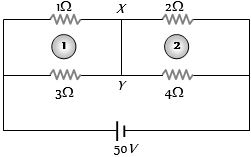
- 2Current through wire $XY$ of circuit shown is ................ $A$View Solution
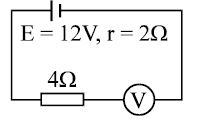
- 3By error, a student places moving-coil voltmeter $V$ (nearly ideal) in series with the resistance in a circuit in order to read the current, as shown. The voltmeter reading will be ............ $V$View Solution
- 4A wire of length $100\, cm$ is connected to a cell of $emf$ $2\, V$ and negligible internal resistance. The resistance of the wire is $3\, \,\Omega$. The additional resistance required to produce a potential drop of $1$ milli volt per cm is ............... $\Omega $View Solution
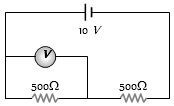
- 5A voltmeter of resistance $1000\,\Omega$ is connected across a resistance of $500\, \Omega$ in the given circuit. What will be the reading of voltmeter .............. $V$View Solution
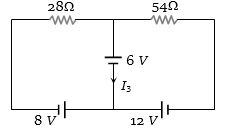
- 6Consider the circuit shown in the figure. The current ${I_3}$ is equal toView Solution
- 7$12$ cells each having same $emf$ are connected in series with some cells wrongly connected. The arrangement is connected in series with an ammeter and two cells which are in series. Current is $3 \,A$ when cells and battery aid each other and is $2\, A$ when cells and battery oppose each other. The number of cells wrongly connected isView Solution
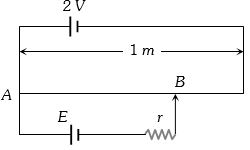
- 8In the given figure, battery $E $ is balanced on $55\, cm$ length of potentiometer wire but when a resistance of $10 \,\Omega$ is connected in parallel with the battery then it balances on $50\, cm$ length of the potentiometer wire then internal resistance $r$ of the battery is ............. $\Omega $View Solution
- 9Different combination of $3$ resistors of equal resistance $R$ are shown in the figures.View Solution
The increasing order for power dissipation is: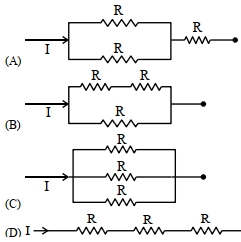
- 10View SolutionThe reciprocal of resistance is