Hot water cools from ${60^o}C$ to ${50^o}C$ in the first $10$ minutes and to ${42^o}C$ in the next $10$ minutes. The temperature of the surrounding is ......... $^oC$
Diffcult


Download our appand get started for free
Experience the future of education. Simply download our apps or reach out to us for more information. Let's shape the future of learning together!No signup needed.*
Similar Questions
- 1View SolutionThe layers of atmosphere are heated through
- 2The area of the hole of heat furnace is $10^{-4}\,m^2.$ It radiates $1.58\times 10^5\,cal$ of heat per hour. If the emissivity of the furnace is $0.80,$ then its temperature is .......... $K$View Solution
- 3A body cools from ${50.0^o}C$ to ${49.9^o}C$ in $5\;s$. How long will it take to cool from ${40.0^o}C$ to ${39.9^o}C$? Assume the temperature of surroundings to be ${30.0^o}C$ and Newton's law of cooling to be valid ....... $\sec$View Solution
- 4Two cylinders $P$ and $Q$ have the same length and diameter and are made of different materials having thermal conductivities in the ratio $2 : 3$ . These two cylinders are combined to make a cylinder. One end of $P$ is kept at $100°C$ and another end of $Q$ at $0°C$ . The temperature at the interface of $P$ and $Q$ is ...... $^oC$View Solution
- 5In a steady state, the temperature at the end $A$ and $B$ of $20\,cm$ long rod $AB$ are $100\,^oC$ and $0\,^oC$ respectively. The temperature of a point $9\,cm$ from $A$ is....... $^oC$View Solution
- 6A sphere, a cube and a thin circular plate, all made of the same material and having the same mass are initially heated to a temperature of $1000°C$ . Which one of these will cool firstView Solution
- 7Two sheets of thickness $d$ and $3d$, are touching each other. The temperature just outside the thinner sheet side is $A$, and on the side of the thicker sheet is $C$. The interface temperature is $B. A, B$ and $C$ are in arithmetic progressing, the ratio of thermal conductivity of thinner sheet and thicker sheet isView Solution
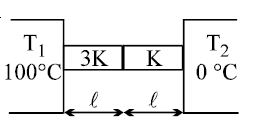
- 8A metal ball of surface area $200\;c{m^2}$ and temperature ${527^o}C$ is surrounded by a vessel at ${27^o}C$. If the emissivity of the metal is $0.4$ , then the rate of loss of heat from the ball is .......... $joules $ approx. $(\sigma = 5.67 \times {10^{ - 8}}J/{m^2}\; - s - {k^4})$View Solution
- 9Three large identical plates are kept parallel to each other. The outer two plates are maintained at temperatures $T$ and $2 T$, respectively. The temperature of the middle plate in steady state will be close to ........... $T$View Solution
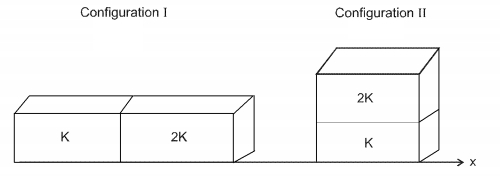
- 10Two rectangular blocks, having indentical dimensions, can be arranged either in configuration $I$ or in configuration $II$ as shown in the figure, On of the blocks has thermal conductivity $k$ and the other $2 \ k$. The temperature difference between the ends along the $x$-axis is the same in both the configurations. It takes $9\ s$ to transport a certain amount of heat from the hot end to the cold end in the configuration $I$. The time to transport the same amount of heat in the configuration $II$ is :View Solution