Two rods, one made of copper and the other steel of the same length and cross-sectional area are joined together. The thermal conductivity of copper is $385 \,Js ^{-1} m ^{-1} K ^{-1}$ and steel is $50 \,Js ^{-1} m ^{-1} K ^{-1}$. If the copper end is held at $100^{\circ} C$ and the steel end is held at $0^{\circ} C$, the junction temperature is ........... $C$ (Assuming no other heat losses)
KVPY 2011, Medium
Download our app for free and get started
(d)
Let junction temperature is $T^{\circ} C$.
Then, assuming no heat loss and steady state,
Heat flow through copper rod per second $=$ Heat flow through steel rod per second
$\Rightarrow \frac{K_{\text {Copper }} A(100-T)}{l}=\frac{K_{\text {steel }} A(T-0)}{l}$
$\Rightarrow \quad K_{\text {Copper }}(100-T)=K_{\text {steel }} \cdot T$
$\therefore$ Area and length of both rods are equal.
$\therefore$ Area and length of both rods are equal.
Substituting values, we get
$385(100-T)=50 \,T$
$\Rightarrow \quad 385 \times 100=(385+50) \,T$
$\Rightarrow \quad T=\frac{385 \times 100}{435} \approx 88^{\circ} C$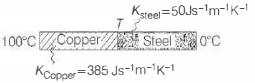

Download our appand get started for free
Experience the future of education. Simply download our apps or reach out to us for more information. Let's shape the future of learning together!No signup needed.*
Similar Questions
- 1$Assertion :$ Two thin blankets put together are warmer than a single blanket of double the thickness.View Solution
$Reason :$ Thickness increases because of air layer enclosed between the two blankets. - 2A black coloured solid sphere of radius $R$ and mass $M$ is inside a cavity with vacuum inside. The walls of the cavity are maintained at temperature $T_0$. The initial temperature of the sphere is $3T_0$. If the specific heat of the material of the sphere varies as $\alpha T^3$ per unit mass with the temperature $T$ of the sphere, where $\alpha $ is a constant, then the time taken for the sphere to cool down to temperature $2T_0$ will be ( $\sigma $ is Stefan Boltzmann constant)View Solution
- 3Consider two hot bodies ${B_1}$ and ${B_2}$ which have temperatures ${100^o}C$ and ${80^o}C$ respectively at $t = 0$. The temperature of the surroundings is ${40^o}C$. The ratio of the respective rates of cooling ${R_1}$ and ${R_2}$ of these two bodies at $t = 0$ will beView Solution
- 4View SolutionThe spectral energy distribution of star is maximum at twice temperature as that of sun. The total energy radiated by star is
- 5A body cools from ${50.0^o}C$ to ${49.9^o}C$ in $5\;s$. How long will it take to cool from ${40.0^o}C$ to ${39.9^o}C$? Assume the temperature of surroundings to be ${30.0^o}C$ and Newton's law of cooling to be valid ....... $\sec$View Solution
- 6A body initially at $80^o C$ cools to $64^o C$ in $5$ minutes and to $52^o C$ in $10 $ minutes. The temperature of the body after $15$ minutes will be ...... $^oC$View Solution
- 7A sphere of ice at $0^o C$ having initial radius $R$ is placed in an environment having ambient temperature $> 0^o C$. The ice melts uniformly, such that shape remains spherical. After a time $‘t’$ the radius of the sphere has reduced to$r$. Assuming the rate of heat absorption is proportional to the surface area of the sphere at any moment, which graph best depicts $r (t)$.View Solution
- 8The absolute temperatures of two black bodies are $2000 K$ and $3000 K$ respectively. The ratio of wavelengths corresponding to maximum emission of radiation by them will beView Solution
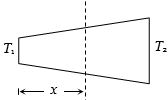
- 9Radius of a conductor increases uniformly from left end to right end as shown in fig.Material of the conductor is isotropic and its curved surface is thermally isolated from surrounding. Its ends are maintained at temperatures $T_1$ and $T_2$ ($T_1$ > $T_2$): If, in steady state, heat flow rate is equal to $H$ , then which of the following graphs is correctView Solution
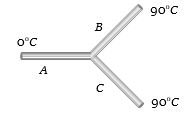
- 10Three rods made of the same material and having the same cross section have been joined as shown in the figure. Each rod is of the same length. The left and right ends are kept at ${0^o}C$ and ${90^o}C$ respectively. The temperature of the junction of the three rods will be ...... $^oC$View Solution