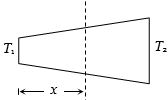
Radius of a conductor increases uniformly from left end to right end as shown in fig.Material of the conductor is isotropic and its curved surface is thermally isolated from surrounding. Its ends are maintained at temperatures $T_1$ and $T_2$ ($T_1$ > $T_2$): If, in steady state, heat flow rate is equal to $H$ , then which of the following graphs is correct
Easy
Download our app for free and get started
(b) Since the curved surface of the conductor is thermally insulated, therefore, in steady state, the rate of flow of heat at every section will be the same. Hence the curve between $H$ and $ x$ will be straight line parallel to $x$ -axis.

Download our appand get started for free
Experience the future of education. Simply download our apps or reach out to us for more information. Let's shape the future of learning together!No signup needed.*
Similar Questions
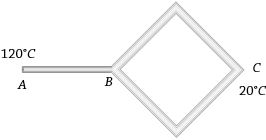
- 1Five identical rods are joined as shown in figure. Point $A$ and $C$ are maintained at temperature $120^o C$ and $20^o C$ respectively. The temperature of junction $B$ will be....... $^oC$View Solution
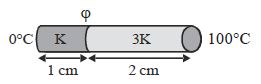
- 2Two bars of thermal conductivities $K$ and $3K$ and lengths $1\,\, cm$ and $2\,\, cm$ respectively have equal cross-sectional area, they are joined lengths wise as shown in the figure. If the temperature at the ends of this composite bar is $0\,^oC$ and $100\,^oC$ respectively (see figure), then the temperature $\varphi $ of the interface is......... $^oC$View Solution
- 3View SolutionIn rainy season, on a clear night the black seat of a bicycle becomes wet because
- 4Assertion : The equivalent thermal conductivity of two plates of same thickness in contact is less than the smaller value of thermal conductivity.View Solution
Reason : For two plates of equal thickness in contact the equivalent thermal conductivity is given by : $\frac{1}{K} = \frac{1}{{{K_1}}} + \frac{1}{{{K_2}}}$ - 5When $p$ calories of heat is given to a body, it absorbs $q$ calories; then the absorbtion power of body will beView Solution
- 6The area of a hole of heat furnace is ${10^{ - 4}}{m^2}$. It radiates $1.58 \times {10^5}$ calories of heat per hour. If the emissivity of the furnace is $0.80$ , then its temperature is....... $K$View Solution
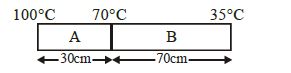
- 7Two different rods $A$ and $B$ are kept as shown in figure. The ratio of thermal conductivities of $A$ and $B$ isView Solution
- 8Many exoplanets have been discovered by the transit method, where in one monitors, a dip in the intensity of the parent star as the exoplanet moves in front of it. The exoplanet has a radius $R$ and the parent star has radius $100 \,R$. If $I_0$ is the intensity observed on earth due to the parent star, then as the exoplanet transitsView Solution
- 9Two identical metal balls at temperature ${200^o}C$and ${400^o}C$ kept in air at ${27^o}C$. The ratio of net heat loss by these bodies isView Solution
- 10In a steady state of thermal conduction, temperature of the ends $A$ and $B$ of a $20\, cm$ long rod are ${100^o}C$ and ${0^o}C$ respectively. What will be the temperature of the rod at a point at a distance of $6$ cm from the end $A$ of the rod....... $^oC$View Solution