Two simple pendulums of lengths $1.44 \,m$ and $1\, m$ start swinging together. After how many vibrations will they again start swinging together
Medium
Download our app for free and get started
(b) $n \propto \frac{1}{{\sqrt l }}$==> $\frac{{{n_2}}}{{{n_1}}}$$ = \sqrt {\frac{{1.44}}{1}} = \frac{{1.2}}{1}$==> ${n_2} = 1.2\,{n_1}$
For $n2$ be integer minimum value of $n1$ should be $5$ and then $n2 = 6$ i.e., after $6 $ oscillations of smaller pendulum both will be in phase.

Download our appand get started for free
Experience the future of education. Simply download our apps or reach out to us for more information. Let's shape the future of learning together!No signup needed.*
Similar Questions
- 1A uniform cylinder of length $L$ and mass $M$ having cross-sectional area $A$ is suspended, with its length vertical, from a fixed point by a massless spring, such that it is half submerged in a liquid of density $\sigma $ at equilibrium position. When the cylinder is given a downward push and released, it starts oscillating vertically with a small amplitude. The time period $T$ of the oscillations of the cylinder will beView Solution
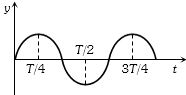
- 2View SolutionThe graph shows the variation of displacement of a particle executing S.H.M. with time. We infer from this graph that
- 3A mass $m$ attached to a spring oscillates every $2\, sec$. If the mass is increased by $2 \,kg$, then time-period increases by $1\, sec$. The initial mass is ..... $kg$View Solution
- 4If the length of a clock pendulum increases by $0.2 \%$ due to atmospheric temperature rise, then the loss in time of clock per day is ........... $s$View Solution
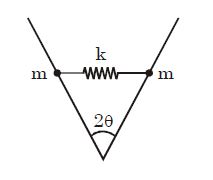
- 5Two particles of mass $m$ are constrained to move along two horizontal frictionless rails that make an angle $2\theta $ with respect to each other. They are connected by a spring with spring constant $k$ . The angular frequency of small oscillations for the motion where the two masses always stay parallel to each other (that is the distance between the meeting point of the rails and each particle is equal) isView Solution
- 6A particle of mass $200 \,gm$ executes $S.H.M.$ The restoring force is provided by a spring of force constant $80 \,N / m$. The time period of oscillations is .... $\sec$View Solution
- 7The angular frequency of a spring block system is $\omega _0.$ This system is suspended from the ceiling of an elevator moving downwards with a constant speed $v_0.$ The block is at rest relative to the elevator. Lift is suddenly stopped. Assuming the downwards as a positive direction, choose the wrong statement :View Solution
- 8The amplitude of a wave represented by displacement equationView Solution
$y = \frac{1}{{\sqrt a }}\,\sin \,\omega t \pm \frac{1}{{\sqrt b }}\,\cos \,\omega t$ will be
- 9If a Second's pendulum is moved to a planet where acceleration due to gravity is $4$ times, the length of the second's pendulum on the planet should be made .......... timesView Solution
- 10A spring having a spring constant $‘K’$ is loaded with a mass $‘m’$. The spring is cut into two equal parts and one of these is loaded again with the same mass. The new spring constant isView Solution