Two simple pendulums of lengths $1.44 \,m$ and $1\, m$ start swinging together. After how many vibrations will they again start swinging together
Medium


Download our appand get started for free
Experience the future of education. Simply download our apps or reach out to us for more information. Let's shape the future of learning together!No signup needed.*
Similar Questions
- 1Abody performs simple harmonic oscillations along the straight line $ABCDE$ with $C$ as the midpoint of $AE.$ Its kinetic energies at $B$ and $D$ are each one fourth of its maximum value. If $AE = 2R,$ the distance between $B$ and $D$ isView Solution

- 2View SolutionA simple pendulum is taken from the equator to the pole. Its period
- 3Starting from the mean position a body oscillates simple harmonically with a period of $2\,s.$ After what time will its kinetic energy be $75\%$ of the total energy ?View Solution
- 4View SolutionThe phase difference between the instantaneous velocity and acceleration of a particle executing simple harmonic motion is
- 5A particle of mass $m$ moves in a one-dimensional potential energy $U(x) = -ax^2 + bx^4,$ where $'a'$ and $'b'$ are positive constants. The angular frequency of small oscillations about the minima of the potential energy is equal toView Solution
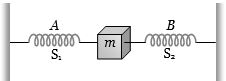
- 6In the figure, ${S_1}$ and ${S_2}$ are identical springs. The oscillation frequency of the mass $m$ is $f$. If one spring is removed, the frequency will becomeView Solution
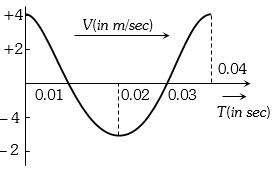
- 7The velocity-time diagram of a harmonic oscillator is shown in the adjoining figure. The frequency of oscillation is ..... $Hz$View Solution
- 8A force of $6.4\ N$ stretches a vertical spring by $0.1\ m$. The mass that must be suspended from the spring so that it oscillates with a time period of $\pi/4\ second$ is .... $kg$View Solution
- 9A particle executes simple hormonic motion between $x =\, -A$ and $x = +A$ . It starts from $x = 0$ moves in $+x-$ direction. The time taken for it to move from $x = 0$ to $x = \frac {A}{2}$ is $T_1$ and to move from $\frac {A}{2}$ to $\frac {A}{\sqrt 2}$ is $T_2$ , thenView Solution
- 10A simple pendulum oscillates in air with time period $T$ and amplitude $A$. As the time passesView Solution