MCQ
Two small balls having the same mass and charge and located on the same vertical at heights h1 and h2 are thrown in the same direction along the horizontal at the same velocity v. The first ball touches the ground at a distance l from the initial vertical. At what height H2 will the second ball be at this instant ? The air drag and the effect of the charges induced on the ground should be neglected.
  • A
    $\text{h}_1+\text{h}_2-\text{g}\Big(\frac{\ell}{\text{V}}\Big)^2$
  • B
    $\text{h}_1-\text{h}_2-\text{g}\Big(\frac{\ell}{\text{V}}\Big)^2$
  • C
    $\text{h}_1+\text{h}_2-\text{g}\Big(\frac{\ell}{\text{V}}\Big)^\frac{1}{2}$
  • D
    $\frac{\text{h}_1+\text{h}_2}{-\text{g}}-\text{g}\Big(\frac{\ell}{\text{V}}\Big)^2$

Answer

  1. $\text{h}_1+\text{h}_2-\text{g}\Big(\frac{\ell}{\text{V}}\Big)^2$

Need a full question paper?

Generate a complete, print-ready paper with questions like this in minutes — across 16+ boards, with answer keys.

Start Generating Free

Similar questions

Which of the following statements concerning the depletion zone of an unbiased PN junction is (are) true

(a) The width of the zone is independent of the densities of the dopants (impurities)

(b) The width of the zone is dependent on the densities of the dopants

(c) The electric field in the zone is produced by the ionized dopant atoms

(d) b, c

A perpendicular material is place in a magnetic fields. Consider the following statemetns:
  1. If the magnetic field is increased, the magnetization is increased.
  2. If the temperature is increased, the magnetization is increased.
  1. Both A and B are true.
  2. A is true but B is false.
  3. B is true but A is false.
  4. Both A and B are false.

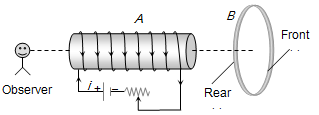
An aluminium ring B faces an electromagnet A. The current I through A can be altered

(a) Whether I increases or decreases, B will not experience any force

(b) If I decrease, A will repel B

(c) If I increases, A will attract B

(d) If I increases, A will repel B

The earth's magnetic field at a certain place has a horizontal component 0.3 Gauss and the total strength 0.5 Gauss. The angle of dip is

(a)  

(b)

(c)

(d)  

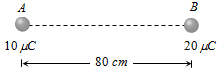
In the given figure distance of the point from A where the electric field is zero is

(a) 20 cm

(b) 10 cm

(c) 33 cm

(d) None of these

The wavelength Ka X-rays produced by an X-ray tube is 0.76 Å. The atomic number of anticathode material is

(a) 82       

(b) 41

(c) 20    

(d) 10

A hole diffuses from the p-side to the n-side in a p-n junction. This means that.
  1. A bond ia broken on the n-side and the electron freed from the bond jumps to the conduction band.
  2. A conduction electron on the p-side jumps to a broken bond to complete it.
  3. A bond is broken on the n-side and the electron freed from the bond jumps to a broken bond on the p-side to complete it.
  4. A bond is broken on the p-side and the electron freed from the bond jumps to a broken bond on the n-side to complete it.

The unit of inductance is

(a) Volt/ampere

(b) Joule/ampere

(c) Volt-sec/ampere

(d) Volt-ampere/sec

According to Bohr’s theory of H atom, an electron can revolve around a proton indefinitely, if its path is:
Electric conduction in a semiconductor takes place due to: