A pellet carrying a charge of $0.5$ coulomb is accelerated through a potential of $2000$ volts. It attains some kinetic energy equal to
Easy
Download our app for free and get started
(b)
$K E=q V$
$K E=(0.5)(2000)=1000 \,J$

Download our appand get started for free
Experience the future of education. Simply download our apps or reach out to us for more information. Let's shape the future of learning together!No signup needed.*
Similar Questions
- 1A parallel plate capacitor has plate of length $'l',$ width $'w'$ and separation of plates is $'d'.$ It is connected to a battery of emf $V$. A dielectric slab of the same thickness '$d$' and of dielectric constant $k =4$ is being inserted between the plates of the capacitor. At what length of the slab inside plates, will be energy stored in the capacitor be two times the initial energy stored$?$View Solution
- 2A parallel plate air capacitor has a capacitance $C$. When it is half filled with a dielectric of dielectric constant $5$, the percentage increase in the capacitance will be.....$\%$View Solution
- 3Two identical positive charges are placed at $x =\, -a$ and $x = a$ . The correct variation of potential $V$ along the $x-$ axis is given byView Solution
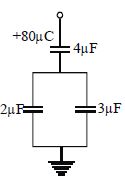
- 4In the given circuit, a charge of $+80\, \mu C$ is given to the upper plate of the $4\,\mu F$ capacitor. Then in the steady state, the charge on the upper plate of the $3\,\mu F$ capacitor is.....$\mu C$View Solution
- 5Electric potential at an equatorial point of a small dipole with dipole moment $P$ ($r$, distance from the dipole) isView Solution
- 6If an electron moves from rest from a point at which potential is $50\, volt$ to another point at which potential is $70\, volt$, then its kinetic energy in the final state will beView Solution
- 7At a distance $l$ from a uniformly charged long wire, a charged particle is thrown radially outward with a velocity $u$ in the direction perpendicular to the wire. When the particle reaches a distance $2 l$ from the wire, its speed is found to be $\sqrt{2} u$. The magnitude of the velocity, when it is a distance $4 l$ away from the wire is (ignore gravity)View Solution
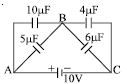
- 8View SolutionIn the circuit shown in figure, four capacitors are connected to a battery. A capacitor is connected to a battery. The force of attraction between the plates when the separation between them is halved
- 9Electric field at a point $(x, y, z)$ is represented by $\vec E = 2x\hat i + {y^2}\hat j$ if potential at $(0,0,0)$ is $2\, volt$ find potential at $(1, 1, 1)$View Solution
- 10The electric potential $V$ at any point $(x, y, z),$ all in metres in space is given by $V = 4x^2$ volt. The electric field at the point $(1, 0, 2)$ in volt/meter, isView Solution