MCQ
Two soap bubbles have different radii but their surface tension is the same. Mark the correct statement
  • Internal pressure of the smaller bubble is higher than the internal pressure of the larger bubble
  • B
    Pressure of the larger bubble is higher than the smaller bubble
  • C
    Both bubbles have the same internal pressure
  • D
    None of the above

Answer

Correct option: A.
Internal pressure of the smaller bubble is higher than the internal pressure of the larger bubble
(a)$\Delta P=\frac{4 T}{R} \therefore \Delta P \propto \frac{1}{R} \quad(T=\text { constant })$Hence, the internal pressure of smaller bubble is larger than that of larger bubble.

Need a full question paper?

Generate a complete, print-ready paper with questions like this in minutes — across 16+ boards, with answer keys.

Start Generating Free

Similar questions

Which of the following sets of factors will affect the horizontal distance covered by an athlete in a long-jump event
A Carnot's engine used first an ideal monoatomic gas then an ideal diatomic gas. If the source and sink temperature are $411^{\circ} \mathrm{C}$ and $69^{\circ} \mathrm{C}$ respectively and the engine extracts $1000 \mathrm{~J}$ of heat in each cycle, then area enclosed by the PV diagram is
A plumb line is suspended from a ceiling of a car moving with horizontal acceleration of $a$. What will be the angle of inclination with vertical
The compressibility of a material is
Two like magnetic poles of strength 10 and $40 \mathrm{Sl}$ units are separated by a distance $30 \mathrm{~cm}$. The intensity of magnetic field is zero on the line joining them
Two coherent sources of light can be obtained by
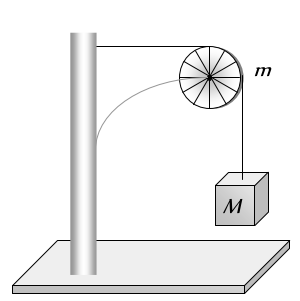
A string of negligible mass going over a clamped pulley of mass $m$ supports a block of mass $M$ as shown in the figure. The force on the pulley by the clamp is given by

Image

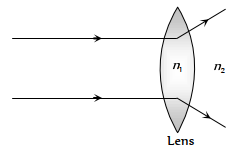
The relation between $n$ and $n$, if behaviour of light rays is as shown in figure is
Image
The rectangular surface of area $8 \mathrm{~cm} \times 4 \mathrm{~cm}$ of a black body at a temperature of $127^{\circ} \mathrm{C}$ emits energy at the rate of $E$ per second. If the length and breadth of the surface are each reduced to half of the initial value and the temperature is raised to $327^{\circ} \mathrm{C}$, the rate of emission of energy will become
If $\stackrel{\circ}{A} \stackrel{\circ}{ u } \stackrel{\circ}{B} \quad \stackrel{\circ}{B} u A$ then the angle between $A$ and $B$ is