MCQ
The compressibility of a material is
  • A
    Product of volume and its pressure
  • The change in pressure per unit change in volume strain
  • C
    The fractional change in volume per unit change in pressure
  • D
    None of the above

Answer

Correct option: B.
The change in pressure per unit change in volume strain
The fractional change in volume per unit change in pressure

Need a full question paper?

Generate a complete, print-ready paper with questions like this in minutes — across 16+ boards, with answer keys.
Start Generating Free

Similar questions

The ratio of longest wavelength and the shortest wavelength observed in the five spectral series of emission spectrum of hydrogen is
Two bodies of masses $m_1$ and $m_2$ have equal kinetic energies. If $p_1$ and $p_2$ are their respective momentum, then ratio $p_1: p_2$ is equal to
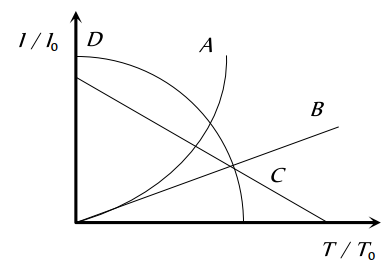
The ratio of thermionic currents $(I / I)$ for a metal when the temperature is slowly increased $T_0$ to $T$ as shown in figure. ( $I$ and $I$ are currents at $T$ and respectively). Then which one is correct?

Image

X-rays can be used to study crystal structure, if the wavelength lies in the range
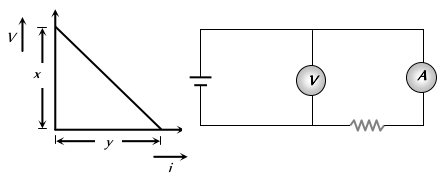
In an experiment, a graph "was plotted of the potential difference $V$ between the terminals of a cell against the circuit current $i$ by varying load rheostat. Internal conductance of the cell is given by

Image

Two masses $m_A$ and $m_B$ moving with velocities $v_A$ and $v_B$ in opposite directions collide elastically. After that the masses $m_A$ and $m_B$ move with velocity $v_B$ and $v_A$ respectively. The ratio $\left(m_A / m_B\right)$ is
A vessel, whose bottom has round holes with diameter of $0.1 \mathrm{~mm}$, is filled with water. The maximum height to which the water can be filled without leakage is (S.T. of water $=75$ dyne $/ \mathrm{cm}, \mathrm{g}=1000 \mathrm{~cm} / \mathrm{s}$ )
The vertical component of earth's magnetic field is zero at or The earth's magnetic field always has a vertical component except at the
Newton's first law of motion describes the following
The amount of substance liberated on electrodes during electrolysis when 1 coulomb of electricity is passed, is