MCQ
Two soap bubbles of radii $3r$ and $4r$ in contact with each other. The radius of curvature of the interface between bubbles is
  • A
    $3r$
  • B
    $3.5r$
  • $12r$
  • D
    $r$

Answer

Correct option: C.
$12r$
c
${r_{common}}\, = \,\frac{{{r_1}{r_2}}}{{{r_2} - {r_1}}} = \frac{{12r}}{1} = 12r$

Need a full question paper?

Generate a complete, print-ready paper with questions like this in minutes — across 16+ boards, with answer keys.
Start Generating Free

Similar questions

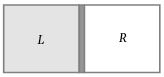
A vessel is partitioned in two equal halves by a fixed diathermic separator. Two different ideal gases are filled in left $(L)$ and right $(R)$ halves. The rms speed of the molecules in $L$ part is equal to the mean speed of molecules in the $R$ part. Then the ratio of the mass of a molecule in $L$ part to that of a molecule in $R$ part is
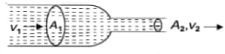
A liquid flows in the tube from left to right as shown in figure. $A_1$ and $A_2$ are the cross-sections of the portions of the tube as shown. The ratio of speed $\frac{v_1}{v_2}$ will be .......... 
In $a$ smooth stationary cart of length $d, a$ small block is projected along it's length with velocity $v$ towards front. Coefficient of restitution for each collision is $e$. The cart rests on $a$ smooth ground and can move freely. The time taken by block to come to rest $w.r.t$. cart is 
A block of mass ${m_1}$ rests on a horizontal table. A string tied to the block is passed on a frictionless pulley fixed at the end of the table and to the other end of string is hung another block of mass ${m_2}$. The acceleration of the system is
On a particular day, the relative humidity is $100\%$ and the room temperature is $30^\circ C,$ then the dew point is:
A projectile thrown with velocity $v$ making angle $\theta$ with vertical gains maximum height $H$ in the time for which the projectile remains in air, the time period is
A satellite is to revolve round the earth in a circle of radius $8000\, km$. The speed at which this satellite be projected into an orbit, will be......... $km/s$
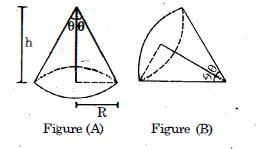
A solid cone is placed on a horizontal surface has height $h$, radius $R$ and apex angle $\theta$ as show.If gravitational potential energy of the cone does not change as position of the cone is changed from figure $(A)$ to figure $(B)$, then,
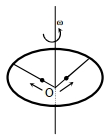
A ring of mass $M$ and radius $R$ is rotating with angular speed $\omega$ about a fixed vertical axis passing through its centre $O$ with two point masses each of mass $\frac{ M }{8}$ at rest at $O$. These masses can move radially outwards along two massless rods fixed on the ring as shown in the figure. At some instant the angular speed of the system is $\frac{8}{9} \omega$ and one of the masses is at a distance of $\frac{3}{5} R$ from $O$. At this instant the distance of the other mass from $O$ is
$A$ body $A$ is thrown vertically upwards with such a velocity that it reaches a maximum height of $h$. Simultaneously another body $B$ is dropped from height $h$. It strikes the ground and does not rebound. The velocity of $A$ relative to $B v/s$ time graph is best represented by : (upward direction is positive)