MCQ
Two sound waves of slightly different frequencies propagating in the same direction produce beats due to:
  • Interference.
  • B
    Diffraction.
  • C
    Reflection.
  • D
    Refraction.

Answer

Correct option: A.
Interference.
Beats are produced on account of interference of sound waves of slightly different frequencies.

Need a full question paper?

Generate a complete, print-ready paper with questions like this in minutes — across 16+ boards, with answer keys.
Start Generating Free

Similar questions

$Assertion$ : The number of significant figures depends on the least count of measuring instrument.
$Reason$ : Significant figures define the accuracy of measuring instrument.
When the velocity of body is variable, then
Two satellites $S _{1}$ and $S _{2}$ are revolving in circular orbits around a planet with radius $R _{1}=3200 \,km$ and $R _{2}=800\, km$ respectively. The ratio of speed of satellite $S_{1}$ to the speed of satellite $S_{2}$ in their respective orbits would be $\frac{1}{ x }$ where $x =$
A heavy stone is thrown from a cliff of height $h$ with a speed $v.$ The stone will hit the ground with maximum speed if it is thrown:
A uniform rope lies on a horizontal table so that a part of it hangs over the edge. The rope begins to slide down when the length of the hanging part is $25\%$ of the entire length. The coefficient of friction between the rope and the table is
The internal energy of a gram-molecule of an ideal gas depends on:
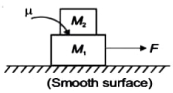
The maximum value of $F$ which can be applied on the system shown in figure so that both blocks move together with same acceleration is .......... 
$n$ drops of $a$ liquid, each with surface energy $E$, joining to form a single drop
Consider two observers moving with respect to each other at a speed $v$ along a straight line. They observe a block of mass $m$ moving a distance $l$ on a rough surface. The following quantities will be same as observed by the two observers.
The velocity and acceleration vectors of a particle undergoing circular motion are $\overrightarrow{ v }=2 \hat{ i } m / s$ and $\overrightarrow{ a }=2 \hat{ i }+4 \hat{ j } m / s ^2$ respectively at an instant of time. The radius of the circle is $........\,m$