MCQ
The internal energy of a gram-molecule of an ideal gas depends on:
  • A
    Pressure alone
  • B
    Volume alone
  • Temperature alone
  • D
    Both on pressure as well as temperature

Answer

Correct option: C.
Temperature alone

Need a full question paper?

Generate a complete, print-ready paper with questions like this in minutes — across 16+ boards, with answer keys.
Start Generating Free

Similar questions

A tuning fork of unknown frequency produoes $4$ beats per second when sounded with another tuning fork of frequency $254 \,Hz$. It gives the same number of beats per second when unknown tuning fork loaded with wax. The unknown frequency before loading with wax is ..........
A hydrogen cylinder is designed to withstand an internal pressure of $100 \,atm$. At $27^{\circ} C$, hydrogen is pumped into the cylinder which exerts a pressure of $20 \,atm$. At what temperature does the danger of explosion first sets in ......... $K$
Dimension of $R$ (Resistance) is
A black body radiates $ 20\,W$ at temperature ${227^o}C$. If temperature of the black body is changed to ${727^o}C$ then its radiating power will be ..... $W$
Which of the diagrams in correctly shows the change in kinetic energy of an iron sphere falling freely in a lake having sufficient depth to impart it a terminal velocity?
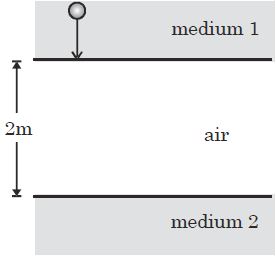
A bead is moving in medium $1$ with a uniform speed of $1\, m \,s^{-1}$ for $2.5\, s$. Then it enters into air and falls freely under gravity for $2\, m$. Finally, it enters medium $2$ and immediately moves with uniform speed for $1.5\, s$. The total distance the bead has traveled, is.........$m$ $(g = 10\, m/s^2$):
Two concentric shells have masses $M$ and $m$ and their raddi are $R$ and $r$ respectively where $R > r$, if $x$ be the distance from the common centre, then what is the gravitational potential at a point for which $r < x < R$
The moment of the force, $\overrightarrow {\;F} = 4\hat i + 5\hat j - 6\hat k$ at $(2, 0, -3),$ about the point $(2, -2, -2),$ is given by
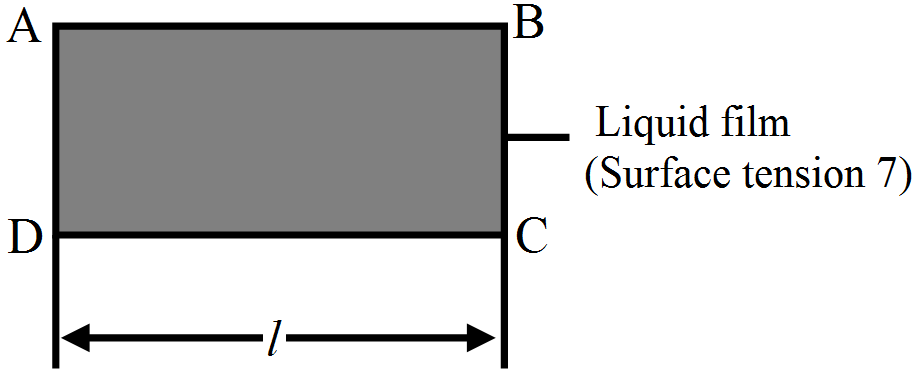
A liquid film is formed over a frame $\text{ABCD}$ as shown in figure. Wire $\text{CD}$ can slide without friction. Maximum value of mass that can be hanged from $\text{CD}$ without breaking the liquid film is:
The period of oscillation of a simple pendulum in the experiment is recorded as $2.63\, s, 2.56 s, 2.42\, s, 2.71\, s$ and $2.80 \,s$ respectively. The average absolute error is ......... $s$