MCQ
When the velocity of body is variable, then
  • A
    Its speed may be constant
  • B
    Its acceleration may be constant
  • C
    Its average acceleration may be constant
  • All of these

Answer

Correct option: D.
All of these
d
(d)

If velocity is changing they may change in magnitude or direction or both.

$(i)$ So, if velocity is changing in direction only the magnitude is constant so speed is constant.

$(ii)$ If only direction of velocity is changing and magnitude is constant then acceleration will also be constant in magnitude (in case of uniform circular motion).

$(iii)$ Average acceleration may be constant. $a_{ av }=\frac{v_2-v_1}{t_2-t_1}$

Need a full question paper?

Generate a complete, print-ready paper with questions like this in minutes — across 16+ boards, with answer keys.
Start Generating Free

Similar questions

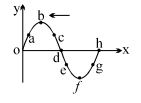
The figure represents the instantaneous picture of a transverse harmonic wave traveling along the negative $x$-axis. Choose the correct alternative $(s)$ related to the movement of the nine points shown in the figure.  The points moving downwards is/are
A disc is rolling, the velocity of its centre of mass is $v_{c m}$. Which one will be correct?
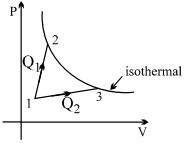
A gas takes part in two processes in which it is heated from the same initial state $1$ to the same final temperature. The processes are shown on the $P-V$ diagram by the straight line $1-2$ and $1-3$. $2$ and $3$ are the points on the same isothermal curve. $Q_1$ and $Q_2$ are the heat transfer along the two processes. Then
Two particles $A$ and $B$ of equal masses are suspended from two massless springs of spring constants $K _{1}$ and $K _{2}$ respectively.If the maximum velocities during oscillations are equal, the ratio of the amplitude of $A$ and $B$ is
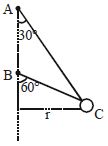
A single wire $ACB$ passes through a smooth ring at $C$ which revolves at a constant speed in the horizontal circle of radius $r$ as shown in the figure. The speed of revolution is
Two particles are in $SHM$ on same straight line with amplitude $A$ and $2A$ and with same angular frequency $\omega .$ It is observed that when first particle is at a distance $A/\sqrt{2}$ from origin and going toward mean position, other particle is at extreme position on other side of mean position. Find phase difference between the two particles
If $H_C, H_K$ and $H_F$ are heat required to raise the temperature of one gram of water by one degree celcius, kelvin and fahrenheit temperature scales respectively then
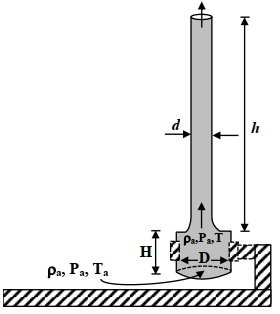
A cylindrical furnace has height $(H)$ and diameter $(D)$ both $1 \mathrm{~m}$. It is maintained at temperature $360 \mathrm{~K}$. The air gets heated inside the furnace at constant pressure $P_a$ and its temperature becomes $T=360 \mathrm{~K}$. The hot air with density $\rho$ rises up a vertical chimney of diameter $d=0.1 \mathrm{~m}$ and height $h=9 \mathrm{~m}$ above the furnace and exits the chimney (see the figure). As a result, atmospheric air of density $\rho_a=1.2 \mathrm{~kg} \mathrm{~m}^{-3}$, pressure $P_a$ and temperature $T_a=300 \mathrm{~K}$ enters the furnace. Assume air as an ideal gas, neglect the variations in $\rho$ and $T$ inside the chimney and the furnace. Also ignore the viscous effects.

[Given: The acceleration due to gravity $g=10 \mathrm{~ms}^{-2}$ and $\pi=3.14$ ]

(image)

($1$) Considering the air flow to be streamline, the steady mass flow rate of air exiting the chimney is

. . . . .$\mathrm{gm} \mathrm{s}^{-1}$.

($2$) When the chimney is closed using a cap at the top, a pressure difference $\Delta P$ develops between the top and the bottom surfaces of the cap. If the changes in the temperature and density of the hot air, due to the stoppage of air flow, are negligible then the value of $\Delta P$ is. . . . .$\mathrm{Nm}^{-2}$.
For a heat engine the heat taken from the hot source is $Q_1$. So,
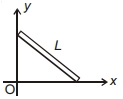
A rod of length $L$ leans against a smooth vertical wall while its other end is on a smooth floor. The end that leans against the wall moves uniformly vertically downward. Select the correct alternative