Two spherical black bodies of radii ${r_1}$ and ${r_2}$ and with surface temperature ${T_1}$and ${T_2}$ respectively radiate the same power. Then the ratio of ${r_1}$ and ${r_2}$ will be
Medium
Download our app for free and get started
(a)For black body, $P = A\varepsilon \sigma {T^4}$. For same power $A \propto \frac{1}{{{T^4}}}$
==> ${\left( {\frac{{{r_1}}}{{{r_2}}}} \right)^2} = {\left( {\frac{{{T_2}}}{{{T_1}}}} \right)^4}$
==> $\frac{{{r_1}}}{{{r_2}}} = {\left( {\frac{{{T_2}}}{{{T_1}}}} \right)^2}$

Download our appand get started for free
Experience the future of education. Simply download our apps or reach out to us for more information. Let's shape the future of learning together!No signup needed.*
Similar Questions
- 1View SolutionWhich of the prism is used to see infra-red spectrum of light
- 2$A$ metal rod of length $2$$m$ has cross sectional areas $2A$ and $A$ as shown in figure. The ends are maintained at temperatures $100°C$ and $70°C$ . The temperature at middle point $C$ is...... $^oC$View Solution

- 3View SolutionIf a liquid is heated in weightlessness, the heat is transmitted through
- 4Radiation from a black body at the thermodynamic temperature $T_1$ is measured by a small detector at distance $d_1$ from it. When the temperature is increased to $T_2$ and the distance to $d_2$ , the power received by the detector is unchanged . What is the ratio $d_2/d_1$ ?View Solution
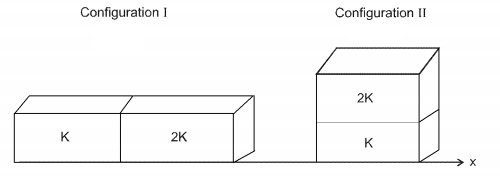
- 5Two rectangular blocks, having indentical dimensions, can be arranged either in configuration $I$ or in configuration $II$ as shown in the figure, On of the blocks has thermal conductivity $k$ and the other $2 \ k$. The temperature difference between the ends along the $x$-axis is the same in both the configurations. It takes $9\ s$ to transport a certain amount of heat from the hot end to the cold end in the configuration $I$. The time to transport the same amount of heat in the configuration $II$ is :View Solution
- 6As per the given figure, two plates $A$ and $B$ of thermal conductivity $K$ and $2 K$ are joined together to form a compound plate. The thickness of plates are $4.0 \,cm$ and $2.5 \,cm$ respectively and the area of cross-section is $120 \,cm ^{2}$ for each plate. The equivalent thermal conductivity of the compound plate is $\left(1+\frac{5}{\alpha}\right) K$, then the value of $\alpha$ will be_______View Solution

- 7The ends $\mathrm{Q}$ and $\mathrm{R}$ of two thin wires, $\mathrm{PQ}$ and $RS$, are soldered (joined) togetker. Initially each of the wires has a length of $1 \mathrm{~m}$ at $10^{\circ} \mathrm{C}$. Now the end $\mathrm{P}$ is maintained at $10^{\circ} \mathrm{C}$, while the end $\mathrm{S}$ is heated and maintained at $400^{\circ} \mathrm{C}$. The system is thermally insulated from its surroundings. If the thermal conductivity of wire $\mathrm{PQ}$ is twice that of the wire $RS$ and the coefficient of linear thermal expansion of $P Q$ is $1.2 \times 10^{-5} \mathrm{~K}^{-1}$, the change in length of the wire $\mathrm{PQ}$ isView Solution
- 8A body cools in $7$ minutes from $60^{\circ}\,C$ to $40^{\circ}\,C$. The temperature of the surrounding is $10^{\circ}\,C$. The temperature of the body after the next $7$ minutes will beView Solution
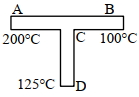
- 9A rod $C D$ of thermal resistance $10.0\; {KW}^{-1}$ is joined at the middle of an identical rod ${AB}$ as shown in figure, The end $A, B$ and $D$ are maintained at $200^{\circ} {C}, 100^{\circ} {C}$ and $125^{\circ} {C}$ respectively. The heat current in ${CD}$ is ${P}$ watt. The value of ${P}$ is ... .View Solution
- 10View SolutionMud houses are cooler in summer and warmer in winter because