$A$ metal rod of length $2$$m$ has cross sectional areas $2A$ and $A$ as shown in figure. The ends are maintained at temperatures $100°C$ and $70°C$ . The temperature at middle point $C$ is...... $^oC$

Medium
Download our app for free and get started
(c) Let $\theta$ be temperature middle point $C$ and in series rate of heat flow is same
==> $K(2A)(100 - \theta ) = KA(\theta - 70)$
==> $200 - 2\theta = \theta - 70$
==> $3\theta = 270$==> $\theta = 90^\circ C$

Download our appand get started for free
Experience the future of education. Simply download our apps or reach out to us for more information. Let's shape the future of learning together!No signup needed.*
Similar Questions
- 1If between wavelength $\lambda $and $\lambda + d\lambda $, ${e_\lambda }$and ${a_\lambda }$ be the emissive and absorptive powers of a body and ${E_\lambda }$ be the emissive power of a perfectly black body, then according to Kirchoff's law, which is trueView Solution
- 2$Assertion :$ Perspiration from human body helps in cooling the body.View Solution
$Reason :$ A thin layer of water on the skin enhances its emissivity. - 3View SolutionTwo thin blankets keep more hotness than one blanket of thickness equal to these two. The reason is
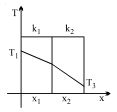
- 4The temperature drop through each layer of a two layer furnace wall is shown in figure. Assume that the external temperature $T_1$ and $T_3$ are maintained constant and $T_1 > T_3$. If the thickness of the layers $x_1$ and $x_2$ are the same, which of the following statements are correct.View Solution
- 5A body takes $5$ minutes to cool from $90^oC$ to $60^oC$. If the temperature of the surroundings is $20^oC$, the time taken by it to cool from $60^oC$ to $30^oC$ will be ...... $\min.$View Solution
- 6The total radiative power emitted by spherical black body with radius $R$ and temperature $T$ is $P$. If the radius is doubled and the temperature is halved, then the radiative power will beView Solution
- 7View SolutionIce is used in a cooler in order to cool its contents. Which of the following will speed up the cooling process?
- 8Two rods one made of copper and other made of steel of the same length and same cross sectional area are joined together. The thermal conductivity of copper and steel are $385\,J\,s ^{-1}\,K ^{-1}\,m ^{-1}$ and $50\,J\,s ^{-1}\,K ^{-1}\,m ^{-1}$ respectively. The free ends of copper and steel are held at $100^{\circ}\,C$ and $0^{\circ}\,C$ respectively. The temperature at the junction is, nearly $.......^{\circ}\,C$View Solution
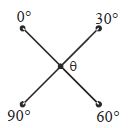
- 9Four rods of same material and having the same cross section and length have been joined, as shown. The temperature of junction of four rods will be........ $^oC$View Solution
- 10View SolutionIn variable state, the rate of flow of heat is controlled by