Question
 
Two statements are given-one labelled Assertion (A) and the other labelled Reason (R). Select the correct answer to these questions from thecodes(a), (b), (c) and (d) as given below.
  1. Both A and R are true and R is the correct explanation of A.
  2. Both A and R are true but R is not the correct explanation of A.
  3. A is true but R is false.
  4. A is false and R is also false.
Assertion: V - I characteristic of p-n diode is same as that of any other conductor.
Reason: p-n diode behave as conductor at room temperature.
Answer

  1. A is false and R is also false.
Explanation:
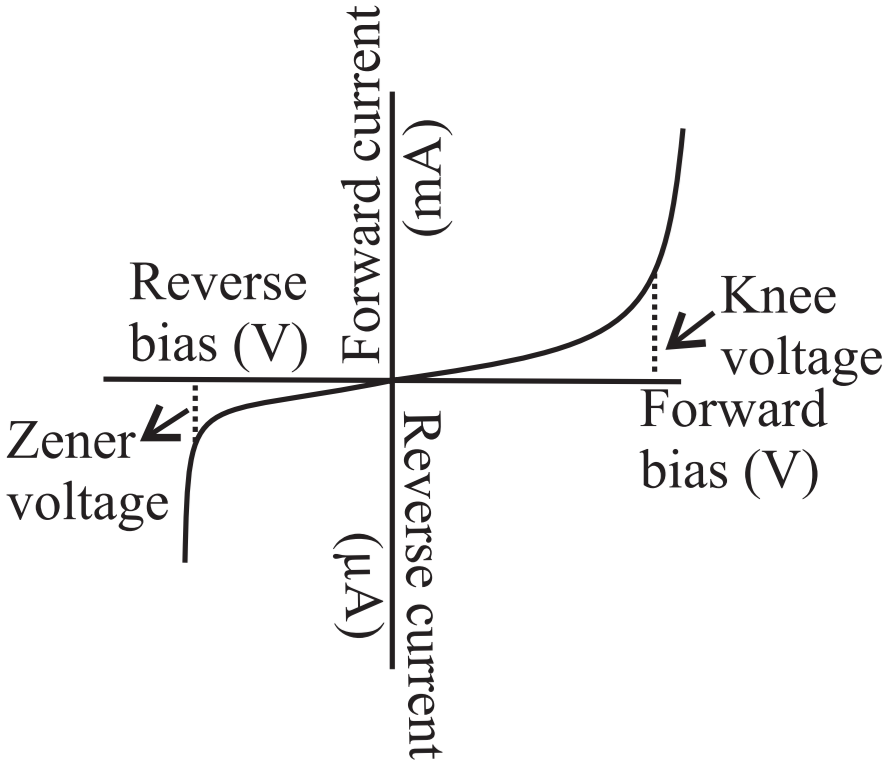
The V - I characteristic of p-n di ode depends whether the junction is forward biased or reverse biased. This can be showed by graph between voltage and current.

In the given graph knee voltage is a voltage at which forward bias becomes greater than the potential barrier, the forward current increases almost linearly, where as zener voltage is a voltage at which reverse current increases suddenly. From this graph we can verify that p-n diode characteristics are very different from that of conductor which obey's Ohm's law.

Need a full question paper?

Generate a complete, print-ready paper with questions like this in minutes — across 16+ boards, with answer keys.

Start Generating Free

Similar questions

Assertion (A): If the frequency of the incident light on a metal surface is doubled, the kinetic energy of emitted electrons is more than doubled.
Reason (R): The metal will provide additional energy to the emitted photoelectron for light of higher frequency than that for lower frequency.
Two statements are given-one labelled Assertion (A) and the other labelled Reason (R). Select the correct answer to these questions from the codes (a), (b ), (c) and (d) as given below.
  1. Both A and R are true and R is the correct explanation of A.
  2. Both A and Rare true but R is NOT the correct explanation of A.
  3. A is true but R is false.
  4. A is false and R is also false.
Assertion (A): Inductance coil are made of copper.
Reason (R): Induced current is more in wire having less resistance.
For question two statements are given-one labelled Assertion (A) and the other labelled Reason (R). Select the correct answer to these questions from the codes (a), (b), (c) and (d) as given below.
  1. Both A and R are true and R is the correct explanation of A.
  2. Both A and R are true but R is NOT the correct explanation of A.
  3. A is true but R is false.
  4. A is false and R is also false.
Assertion (A): The interference pattem is observed when source is monochromatic and coherent.
Reason (R): In Young's double slit experiment, we observe an interference pattern on the screen if both the slits are illuminated by two bulbs of same power.
Two statements are given-one labelled Assertion (A) and the other labelled Reason (R). Select the correct answer to these questions from thecodes(a), (b), (c) and (d) as given below.
  1. Both A and R are true and R is the correct explanation of A.
  2. Both A and R are true but R is not the correct explanation of A.
  3. A is true but R is false.
  4. A is false and R is also false.
Assertion: Diamond behaves like an insulator.
Reason: There is a large energy gap between valence band and conduction band of diamond.
Two statements are given-one labelled Assertion (A) and the other labelled Reason (R). Select the correct answer to these questions from the codes (a), (b), (c) and (d) as given below.
  1. Both A and R are true and R is the correct explanation of A.
  2. Both A and R are true but R is not the correct explanation of A.
  3. A is true but R is false.
  4. A is false and R is also false.
Assertion: The diamond shines due to multiple total intemal reflections.
Reason: The critical angle for diamond is 24.4°.
For two statements are given-one labelled Assertion (A) and the other labelled Reason (R). Select the correct answer to these questions from the codes (a), (b), (c) and (d) as given below.
  1. Both A and R are true, and R is the correct explanation of A.
  2. Both A and R are true, but R is not the correct explanation of A.
  3. A is true but R is false.
  4. A is false and R is also false.
Assertion (A): Sharper is the curvature of spot on a charged body lesser will be the surface charge density at that point.
Reason (R): Electric field is non-zero inside a charged conductor.
For two statements are given-one labelled Assertion (A) and the other labelled Reason (R). Select the correct answer to these questions from the codes (a), (b), (c) and (d) as given below.
  1. Both A and R are true, and R is the correct explanation of A.
  2. Both A and R are true, but R is not the correct explanation of A.
  3. A is true, but R is false.
  4. A is false, and R is also false.
Assertion (A): An electric field is preferred in comparison to magnetic field for detecting the electron beam in a television picture tube.
Reason (R): Electric field requires low voltage.
Two statements are given-one labelled Assertion (A) and the other labelled Reason (R). Select the correct answer to these questions from thecodes(a), (b), (c) and (d) as given below.
  1. Both A and R are true and R is the correct explanation of A.
  2. Both A and R are true but R is not the correct explanation of A.
  3. A is true but R is false.
  4. A is false and R is also false.
Assertion: The depletion layer in the p-n junction is free from mobile charge carriers.
Reason: There is no electric field across the junction barrier.
Two statements are given-one labelled Assertion (A) and the other labelled Reason (R). Select the correct answer to these questions from the codes (a), (b), (c) and (d) as given below.
  1. Both A and R are true and R is the correct explanation of A.
  2. Both A and R are true but R is NOT the correct explanation of A.
  3. A is true but R is false.
  4. A is false and R is also false.
Assertion (A): In a conductor, free electrons keep on moving but no magnetic force acts on a conductor in a magnetic field.
Reason (R): Force on free electron due to magnetic field always acts perpendicular to its direction of motion.
For two statements are given-one labelled Assertion (A) and the other labelled Reason (R). Select the correct answer to these questions from the codes (a), (b), (c) and (d) as given below.
  1. Both A and R are true and R is the correct explanation of A.
  2. Both A and R are true but R is not the correct explanation of A.
  3. A is true but R is false.
  4. A is false and R is also false.
Assertion: An alternating current shows magnetic effect.
Reason: Magnitude of alternating current varies with time.