MCQ
Two stones are thrown up vertically and simultaneously but with different speeds. Which graph correctly represents the time variation of their relative positions $\Delta x$.Assume that stones do not bounce after hitting ground.
- A
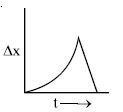
- B
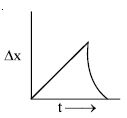
- ✓
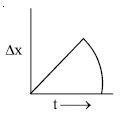
- D
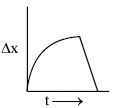
Generate a complete, print-ready paper with questions like this in minutes — across 16+ boards, with answer keys.
$\text{k}$
$\omega$
$\frac{\text{k}}{\omega}$
$\text{k}\omega$
Assertion A :Two identical balls $A$ and $B$ thrown with same velocity '$u$ ' at two different angles with horizontal attained the same range $R$. If $A$ and $B$ reached the maximum height $h_{1}$ and $h_{2}$ respectively, then $R =4 \sqrt{ h _{1} h _{2}}$
Reason R: Product of said heights.
$h _{1} h _{2}=\left(\frac{u^{2} \sin ^{2} \theta}{2 g }\right) \cdot\left(\frac{u^{2} \cos ^{2} \theta}{2 g }\right)$
Choose the $CORRECT$ answer
| $List-I$ | $List-II$ |
| ($I$) $10^{-3} kg$ of water at $100^{\circ} C$ is converted to steam at the same temperature, at a pressure of $10^5 Pa$. The volume of the system changes from $10^{-6} m ^3$ to $10^{-3} m ^3$ in the process. Latent heat of water $=2250 kJ / kg$. | ($P$) $2 kJ$ |
| ($II$) $0.2$ moles of a rigid diatomic ideal gas with volume $V$ at temperature $500 K$ undergoes an isobaric expansion to volume $3 V$. Assume $R=8.0 Jmol ^1 K^{-1}$. | ($Q$) $7 kJ$ |
| ($III$) On mole of a monatomic ideal gas is compressed adiabatically from volume $V=\frac{1}{3} m^3$ and pressure $2 kPa$ to volume $\frac{v}{8}$ | ($R$) $4 kJ$ |
| ($IV$) Three moles of a diatomic ideal gas whose molecules can vibrate, is given $9 kJ$ of heat and undergoes isobaric expansion. | ($S$) $5 kJ$ |
| ($T$) $3 kJ$ |
Which one of the following options is correct?