MCQ
Two trains are moving with equal speed in opposite directions along two parallel railway tracks. If the wind is blowing with speed $u$ along the track so that the relative velocities of the trains with respect to the wind are in the ratio of $1:2$, then the speed of each train must be
  • $3u$
  • B
    $2u$
  • C
    $4u$
  • D
    $u$

Answer

Correct option: A.
$3u$
a
Let the speed of trains be $x$

$\therefore \frac{x-u}{x+u}=\frac{1}{2}$ or $2 x-2 u=x+u$

or $x=3 u$

Need a full question paper?

Generate a complete, print-ready paper with questions like this in minutes — across 16+ boards, with answer keys.

Start Generating Free

Similar questions

The angle between the vectors $\overrightarrow A $ and $\overrightarrow B $ is $\theta .$ The value of the triple product $\overrightarrow A \,.\,(\overrightarrow B \times \overrightarrow A \,)$ is
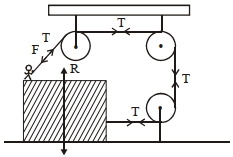
A boy of mass $4\, kg$ is standing on a piece of wood having mass $5 \,kg$. If the coefficient of friction between the wood and the floor is $0.5,$ the maximum force that the boy can exert on the rope so that the piece of wood does not move from its place is ......$N.$(Round off to the Nearest Integer) [Take $g=10 \,ms ^{-2}$ ]
A projectile fired with initial velocity $u$ at some angle $\theta $ has a range $R$. If the initial velocity be doubled at the same angle of projection, then the range will be
Which of the following forces cannot be a resultant of $5\, N$ and $7\, N$ force...........$N$
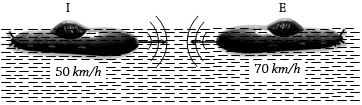
An Indian submarine and an enemy submarine move towards each other during maneuvers in motionless water in the Indian ocean. The Indian submarine moves at $50 km/h$, and the enemy submarine at $70 km/h$. The Indian sub sends out a sonar signal (sound wave in water) at $1000 Hz$. Sonar waves travel at $5500 km/h$. What is the frequency detected by the Indian submarine .... $kHz$
The kinetic energy and the potential energy of a particle executing $S.H.M.$ are equal. The ratio of its displacement and amplitude will be 
If there is no external force acting on a nonrigid body, which of the following quantities must remain constant?
  1. Angular momentum.
  2. Linear momentum.
  3. Kinetic energy.
  4. Moment of inertia.
If a body is in equilibrium under a set of non-collinear forces, then the minimum number of forces has to be
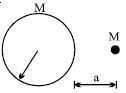
A particle of mass $M$ is at a distance a from surface of a thin spherical shell of equal mass and having radius a.
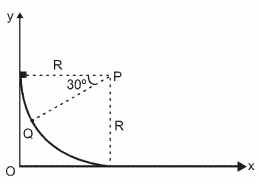
$40 \ m$. The block slides along the track without toppling and a frictional force acts on it in the direction opposite to the instantaneous velocity. The work done in overcoming the friction up to the point $Q$, as shown in the figure below, is $150 \ J$. (Take the acceleration due to gravity, $g =10 \ m s ^{-2}$ )

$1.$ The speed of the block when it reaches the point $Q$ is :

$(A)$ $5 \ ms ^{-1}$ $(B)$ $10 \ ms ^{-1}$$(C)$ $10 \sqrt{3} \ ms ^{-1}$ $(D)$ $20 \ ms ^{-1}$

$2.$ The magnitude of the normal reaction that acts on the block at the point $Q$ is :

$(A)$ $7.5 \ N$ $(B)$ $8.6 \ N$ $(C)$ $11.5 \ N$ $(D)$ $22.5 \ N$

Give the answer question $1$ and $2.$