Two tubes of radii $r_1$ and $r_2$, and lengths $l_1$ and $l_2$, respectively, are connected in series and a liquid flows through each of them in streamline conditions. $P_1$ and $P_2$ are pressure differences across the two tubes. If $P_2$ is $4P_1$ and $l_2$ is $ \frac{l_1}{4}$ , then the radius $r_2$ will be equal to
JEE MAIN 2017, Diffcult


Download our appand get started for free
Experience the future of education. Simply download our apps or reach out to us for more information. Let's shape the future of learning together!No signup needed.*
Similar Questions
- 1An air bubble of radius $r$ rises steadily through a liquid of density $\rho $ with velocity $v$ . The coefficient of viscosity of liquid isView Solution
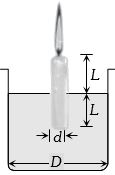
- 2A candle of diameter $ d$ is floating on a liquid in a cylindrical container of diameter $D $ $(D>>d)$ as shown in figure. If it is burning at the rate of $2$ cm/hour then the top of the candle willView Solution
- 3View SolutionWhich of the following is not an assumption for an ideal fluid flow for which Bernoulli's principle is valid
- 4View SolutionWater is flowing through a horizontal pipe of non-uniform cross-section. At the extreme narrow portion of the pipe, the water will have
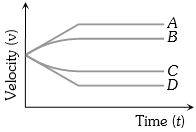
- 5View SolutionA small spherical solid ball is dropped from a great height in a viscous liquid. Its journey in the liquid is best described in the diagram given below by the
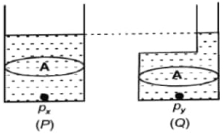
- 6Figure shows two containers $P$ and $Q$ with same base area $A$ and each filled upto same height with same liquid. Select the correct alternative .............View Solution
- 7Two non-mixing liquids of densities $\rho $ and $n \rho \,(n > 1)$ are put in a container. The height of each liquid is $h.$ A solid cylinder of length $L$ and density $d$ is put in this container. The cylinder floats with its axis vertical and length $\rho L (\rho < 1)$ in the denser liquid. The density $d$ is equal toView Solution
- 8Two large, identical water tanks, $1$ and $2$ , kept on the top of a building of height $H$, are filled with water up to height $h$ in each tank. Both the tanks contain an identical hole of small radius on their sides, close to their bottom. A pipe of the same internal radius as that of the hole is connected to tank $2$ , and the pipe ends at the ground level. When the water flows the tanks $1$ and $2$ through the holes, the times taken to empty the tanks are $t_1$ and $t_2$, respectively. If $H=\left(\frac{16}{9}\right) h$, then the ratio $t_1 / t_2$ is. . . . .View Solution
- 9For the situation shown in the figure, water flows on the surface of a fixed plate. TheView Solution
velocity of water as a function of distance $'y'$ is given as : $u = \alpha \left[ {\frac{y}{h} - 2{{\left( {\frac{y}{h}} \right)}^2}} \right]$ . Determine the magnitude of the shear stress that the water applies at the base of the plate. Coefficient of viscosity is $\eta$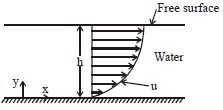
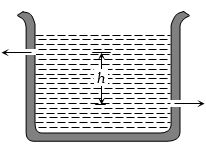
- 10There are two identical small holes of area of cross-section a on the opposite sides of a tank containing a liquid of density $\rho $. The difference in height between the holes is $h$. Tank is resting on a smooth horizontal surface. Horizontal force which will has to be applied on the tank to keep it in equilibrium isView Solution