An air bubble of radius $r$ rises steadily through a liquid of density $\rho $ with velocity $v$ . The coefficient of viscosity of liquid is
Easy
Download our app for free and get started
Steady motion $\Rightarrow \mathrm{a}=0$
$\mathrm{F}_{\mathrm{net}}=0$
$\mathrm{F}_{\mathrm{v}}=\mathrm{F}_{\mathrm{B}}$
$6 \pi \eta r v=\rho \cdot \frac{4}{3} \pi r^{3} g$
$\eta=\frac{2}{9} \frac{\rho r^{2} g}{v}$
$Method \,II:$ Dimensional analysis.

Download our appand get started for free
Experience the future of education. Simply download our apps or reach out to us for more information. Let's shape the future of learning together!No signup needed.*
Similar Questions
- 1Two tubes of radii $r_1$ and $r_2$, and lengths $l_1$ and $l_2$, respectively, are connected in series and a liquid flows through each of them in streamline conditions. $P_1$ and $P_2$ are pressure differences across the two tubes. If $P_2$ is $4P_1$ and $l_2$ is $ \frac{l_1}{4}$ , then the radius $r_2$ will be equal toView Solution
- 2In Millikan's oil drop experiment, what is viscous force acting on an uncharged drop of radius $2.0 \times 10^{-5}\, {m}$ and density $1.2 \times 10^{3} \,{kgm}^{-3}$ ? Take viscosity of liquid $=1.8 \times 10^{-5}\, {Nsm}^{-2} .$ (Neglect buoyancy due to air).View Solution
- 3A large tank is filled with water to a height $H$. A small hole is made at the base of the tank. It takes ${T_1}$ time to decrease the height of water to $\frac{H}{\eta }\,(\eta > 1)$; and it takes ${T_2}$ time to take out the rest of water. If ${T_1} = {T_2}$, then the value of $\eta $ isView Solution
- 4View SolutionAn ice block floats in a liquid whose density is less than water. A part of block is outside the liquid. When whole of ice has melted, the liquid level will
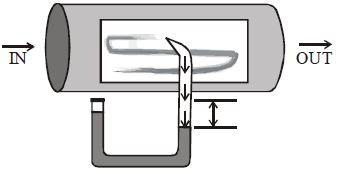
- 5The Pitot tube shown in the figure is used to measure fluid flow velocity in a pipe of cross sectional area $S$. It was invented by a French engineer Henri Pitot in the early $18^{th}$ century. The volume of the gas flowing across the section of the pipe per unit time is (The difference in the liquid columns is $\Delta h, \rho_0$ and $\rho$ are the densities of liquid and the gas respectively) :-View Solution
- 6Two water pipes of diameters $ 2 cm $ and $4 cm $ are connected with the main supply line. The velocity of flow of water in the pipe of $ 2 cm$ diameter isView Solution
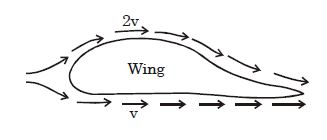
- 7The flow speeds of air on the lower and upper surfaces of the wing of an aeroplane are $v$ and $2v$ respectively. The density of air is $\rho $ and surface area of wing is $A$ . The dynamic lift on the wing isView Solution
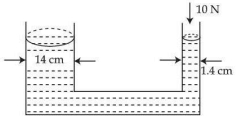
- 8A hydraulic press containing water has two arms with diameters as mentioned in the figure. A force of $10 \mathrm{~N}$ is applied on the surface of water in the thinner arm. The force required to be applied on the surface of water in the thicker arm to maintain equilibrium of water is_________.${N}$.View Solution
- 9In Guericke's experiment to show the effect of atmospheric pressure, two copper hemispheres were tightly fitted to each other to form a hollow sphere and the air from the sphere was pumped out to create vacuum inside. If the radius of each hemisphere is $R$ and the atmospheric pressure is $p$, then the minimum force required (when the two hemispheres are pulled apart by the same force) to separate the hemispheres isView Solution
- 10$Assertion :$ For Reynold’s number $Re > 2000$, the flow of fluid is turbulent.View Solution
$Reason :$ Inertial forces are dominant compared to the viscous forces at such high Reynold’s numbers.