MCQ
Two tuning forks when sounded together produced $4$ beats/sec. The frequency of one fork is $256.$ The number of beats heard increases when the fork of frequency $256$ is loaded with wax. The frequency of the other fork is
  • A
    $504$
  • B
    $520$
  • $260$
  • D
    $252$

Answer

Correct option: C.
$260$
c
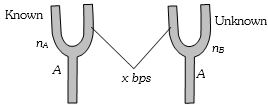
(c) Suppose two tuning forks are named $A$ and $B$ with frequencies ${n_A} = 256\,Hz$ (known), $n_B = ?$ (unknown), and beat frequency $x = 4 \,bps.$

Frequency of unknown tuning fork may be ${n_B} = 256 + 4 = 260\,Hz$ 

or $ = 256 - 4 = 252\,Hz$

It is given that on sounding waxed fork $A$ (fork of frequency $256 Hz$) and fork $B$, number of beats (beat frequency) increases. 

It means that with decrease in frequency of $A,$ the difference in new frequency of $A$ and the frequency of $B$ has increased.

This is possible only when the frequency of $A$ while decreasing is moving away from the frequency of $B.$

This is possible only if $n_B = 260 Hz.$

Alternate method : It is given ${n_A} = 256\,Hz,\,{n_B} = ?$ and $x = 4 \,bps$ 

Also after loading $A$ (i.e. $n_A \downarrow$), beat frequency (i.e. $x$) increases ($\uparrow$).

Apply these informations in two possibilities to known the frequency of unknown tuning fork. 

$n_A \downarrow -n_B = x\uparrow$ ... $(i)$

$n_B -n_A \downarrow = x\uparrow$ ... $(ii)$

It is obvious that equation $(i)$ is wrong $(ii)$ is correct so 

$n_B = n_A + x = 256 + 4 = 260 \,Hz.$
Need a full question paper?

Generate a complete, print-ready paper with questions like this in minutes — across 16+ boards, with answer keys.

Start Generating Free

Similar questions

A bomb is dropped by fighter plane flying horizontally. To an observer sitting in the plane, the trajectory of the bomb is a :
A soap bubble of radius $R$ and surface tension $T$ is formed in vacuum. It is slowly charged so that it slowly expands. It is stopped charging when the radius becomes $2R$ . Find the amount of charge given to the bubble.
A body is executing $S.H.M.$ When its displacement from the mean position is $4\, cm$ and $5\, cm$, the corresponding velocity of the body is $10 \,cm/sec$ and $8\, cm/sec$. Then the time period of the body is
A one litre glass flask contains some mercury. It is found that at different temperatures the volume of air inside the flak remains the same. ...... $cc$ is the volume of mercury in this flask if coefficient of linear expansion of glass is $9 \times 10^{-6}  /^o C$ while of volume expansion of mercury is $1.8 \times {10^4}\,/^\circ C$
The decrease in the potential energy of a ball of mass $20\ kg$ which falls from a height of $50\ cm$ is:
The magnitudes of vectors $\vec A,\,\vec B$ and $\vec C$ are $3, 4$ and $5$ units respectively. If $\vec A + \vec B = \vec C$, the angle between $\vec A$ and $\vec B$ is
A body is moving with variable acceleration $(a)$ along a straight line. The average acceleration of body in time interval $t_1$ to $t_2$ is
Surface tension at critical temperature becomes:
A point moves in $x-y$ plane as per $x=kt,$ $y = kt\left( {1 - \alpha t} \right)$ where $k\,\& \,\alpha \,$ are $+ve$ constants. The equation of trajectory is 
A source of sound of frequency $90$ vibrations/ sec is approaching a stationary observer with a speed equal to $1/10$ the speed of sound. What will be the frequency heard by the observer .... $vibrations/sec$